Oct 15, 2026Flow Meter Selection Guides
Plastic Tube Rotameter Connections: Socket vs Threaded vs Flanged
Socket, threaded or flanged? How to match an LZS plastic tube rotameter connection to your pipework, thread standard and working conditions, and what to send for a quote.
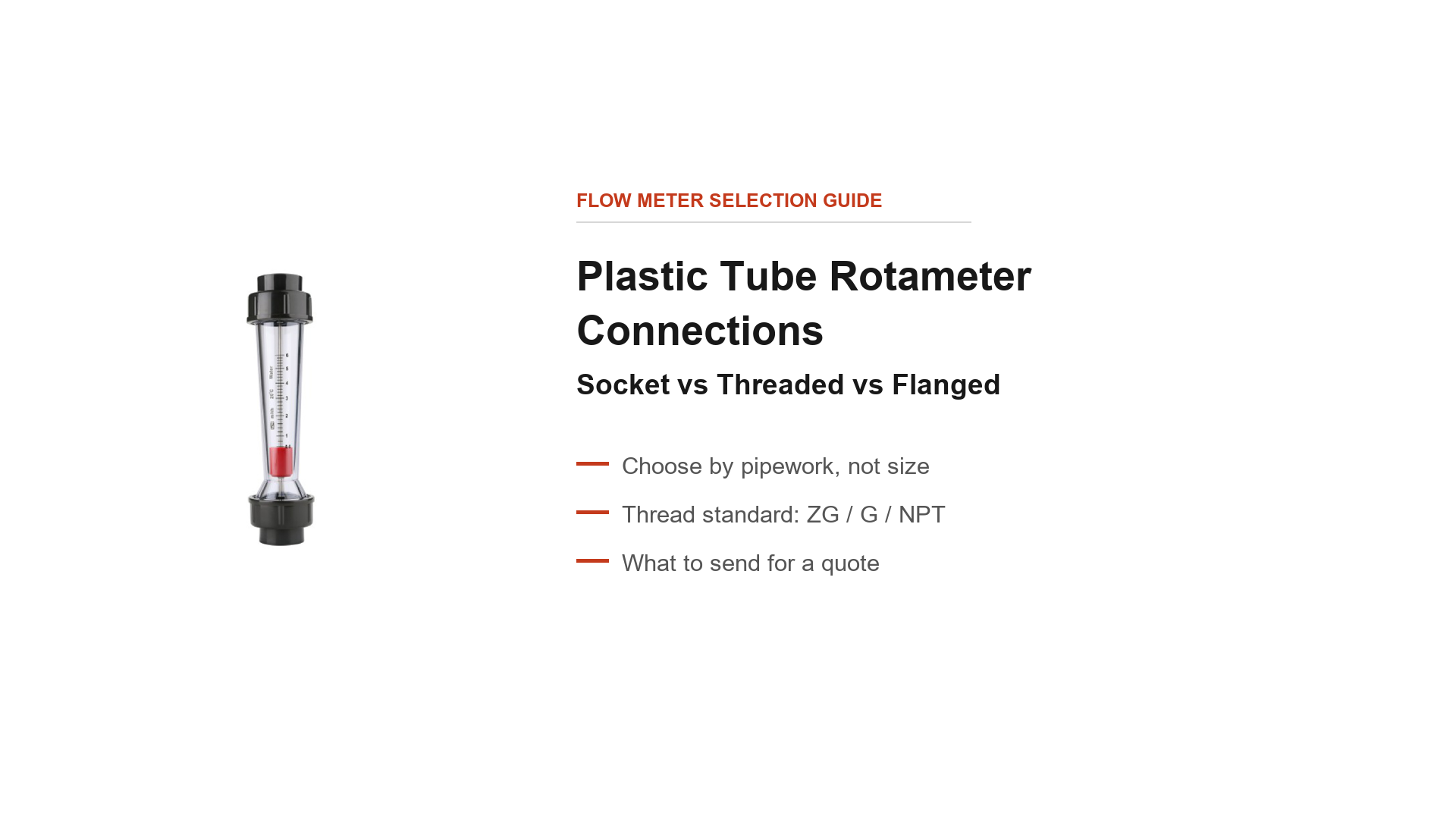
Choosing a plastic tube rotameter is not finished when you have picked the flow range and pipe size. The connection type is a separate decision — and it is the one that most often goes wrong. A meter can have the correct measuring range and still fail to fit the line, leak at the joint, or arrive with a thread that does not match the pipework.
This guide walks through the three connection families for the LZS plastic tube rotameter — socket, threaded and flanged — and what to confirm before ordering, so the meter matches the pipe you already have. It is written for buyers and engineers specifying a meter and requesting a quotation.
The single most useful point up front: pipe size and connection size are not the same thing. A DN25 meter does not automatically mean a 25 mm thread or socket — the connection is a separate specification, confirmed separately from the size.
A quick summary before the detail:
- Socket connections suit small, permanently bonded plastic pipework.
- Threaded connections suit pipework that must be assembled or serviced by hand, and are specified by thread standard (not just size).
- Flanged connections suit larger pipe sizes and lines that need a bolted, gasketed joint.
- Whichever you choose, confirm three things together: the connection standard, the working pressure and temperature, and the material — because these limit which connection a given LZS type can use.
Socket connections
A socket connection (also called an insert or glue connection) joins the meter to plastic pipe through a socket that is bonded to the pipe. The correct bonding method depends on the pipe material and the connector material, so both must be confirmed before ordering.
Choose a socket connection when:
- the pipework is plastic and intended to be permanently joined, not regularly disassembled;
- the line is smaller (socket connections are most common on small to medium plastic lines);
- you want a compact joint with no separate sealing component to lose.
Confirm before ordering:
- the pipe material, the connector material, and the compatible bonding method — confirm that the pipe and the LZS connector can be joined correctly together;
- the pipe outside diameter and material the socket must accept;
- the socket size for the meter — for the LZS socket type this is given as a metric pipe outside diameter in mm (see the table below), not as the DN and not as a thread;
- that the joint can be made properly on site — plastic socket bonding needs suitable conditions and a clean, dry fit.
Threaded connections
A threaded connection screws the meter to the pipework and is defined by thread standard, not by nominal size alone. The LZS threaded type is offered in more than one thread standard — ZG, G and NPT appear across the sizes (see the per-size table below).
Choose a threaded connection when:
- the line must be assembled, removed or serviced without cutting pipe;
- you want to reuse the meter on different skids or test loops;
- the sizes are within the threaded range of the meter.
Confirm before ordering:
- the thread standard (ZG, G or NPT) and whether it is male or female — this is the number one source of "it arrived but won't fit" problems (see below);
- the thread size (for example 1/2 in, 3/4 in, 1 in), which is defined by the standard, not by the DN;
- the sealing method the joint expects, and that it will not be over-tightened (plastic threads can be damaged by excessive force).
The exact thread standard and size for each model are given in the official catalog for that model; confirm them per size rather than assuming one standard covers the whole range.
Thread standard: confirm, do not assume
More than one tapered pipe-thread standard appears on industrial flow meters, and they look similar but should not be assumed to fit each other:
- ZG — a Chinese-standard tapered pipe thread;
- G — a parallel (non-tapered) pipe thread designation that also appears at the larger LZS sizes;
- NPT — the US National Pipe Taper thread.
These are different thread forms. Never assume that a 1/2 in thread of one standard is a direct substitute for another, or that ZG and BSPT are interchangeable. State the required standard, size and the expected sealing method in the enquiry, and if your pipework standard is unknown, measure the fitting or send a photo with the order.
Note: the thread designations above are general industry standards. Confirm the exact standard, size and sealing method for your meter in the quotation rather than assuming from the nominal size.
Flanged connections
A flanged connection bolts the meter between two flanges with a gasket. On the LZS family it is used for larger pipe sizes (the flange type runs from DN15 up to DN300) and where a bolted, gasketed joint is preferred.
Choose a flanged connection when:
- the line is larger than the practical range of socket or threaded connections;
- the joint must be bolted and gasketed;
- the installation needs a joint that can be opened without cutting or unscrewing pipe.
Confirm before ordering:
- the flange standard and dimension (flange standards differ between regions and are not interchangeable even at the same nominal size);
- the bolt hole pattern;
- the gasket and the pressure/temperature boundary the selected flange type is rated for — for the LZS flange type the catalog gives ≤0.6 MPa (DN15–DN150) and ≤0.4 MPa (DN200–DN300), and medium temperature 0 to +60 °C.
What the LZS family actually offers
The LZS family covers three connection approaches. Confirm your size and connection against the type that matches your line:
LZS type | Connection | Sizes | Connection options (as published) |
|---|---|---|---|
LZS socket / threaded | Socket or threaded | DN15, DN20, DN25, DN32, DN40, DN50, DN65 | Socket (metric pipe OD): 20, 25, 32, 40, 50, 63, 75 mm; Thread: ZG, G and NPT — exact standard and size per model, per the official catalog |
LZS flange type | Flange | DN15 up to DN300 | Flange |
LZS-E | Insert (socket), internal or external thread, panel mounting | DN15, DN25, DN32, DN50, DN65 | See product page |
The same LZS metering tube can be supplied with either a socket or a threaded connection, so the meter can be matched to the pipework already in use; this is the LZS socket/threaded type. The exact connection for your size is confirmed at quotation — do not assume that every size is offered with every connection.
Note that the socket size is not the DN. In the catalog, the socket column is given as a metric pipe outside diameter (mm), and the thread column gives the thread standard and size (ZG, G and NPT). By size:
Model | DN | Socket (pipe OD, mm) | Thread (ZG / G / NPT) |
|---|---|---|---|
LZS-15 | 15 | 20 | ZG1/2 in / NPT1/2 in |
LZS-20 | 20 | 25 | ZG3/4 in / NPT3/4 in |
LZS-25 | 25 | 32 | ZG3/4 in / NPT3/4 in |
LZS-32 | 32 | 40 | ZG1 in / NPT1 in |
LZS-40 | 40 | 50 | ZG1-1/2 in / G2 in / NPT2 in |
LZS-50 | 50 | 63 | ZG1-1/2 in / G2 in / NPT2 in |
LZS-65 | 65 | 75 | ZG2 in / G2-1/2 in / NPT2-1/2 in |
This is why the connection must be specified separately from the DN, and confirmed per size at quotation. The exact socket and thread standard and size for each model are given in the official catalog for that model.
Working conditions and materials that limit the connection
The connection cannot be chosen on its own. Each LZS type has size, pressure, temperature and material boundaries that also decide what is suitable:
Item | LZS socket / threaded | LZS flange type | LZS-E |
|---|---|---|---|
Sizes | DN15–DN65 | DN15–DN300 | DN15–DN65 |
Medium temperature | 0 to +60 °C | 0 to +60 °C | 0 to +60 °C (E type); 0 to +100 °C (EG type) |
Working pressure | ≤ 0.6 MPa | ≤ 0.6 MPa (DN15–DN150); ≤ 0.4 MPa (DN200–DN300) | ≤ 1 MPa |
Cone tube | AS | AS | Polycarbonate (PC) or polysulfone (PSU) |
Connector / screw cap | PVC | PVC | PVC |
Practical read-across:
- If your pressure is above 0.6 MPa, the socket/threaded and standard flange types are outside their stated range; the LZS-E is published up to 1 MPa.
- If your temperature is above 60 °C, only the LZS-E (EG type) is published up to 100 °C among these types.
- For larger pipework (above about DN65), the flange type extends to DN300; this is the LZS flange type plastic tube rotameter.
- The connection material (PVC connector on the standard types) is a wetted part, so it must suit the fluid — a correct thread on the wrong material is still a wrong choice.
Installation and servicing conditions to confirm
- How the meter will be accessed — a threaded connection makes future removal easier than a bonded socket; a flanged joint is easiest to inspect.
- Whether the line can be taken out of service to make the joint (bonded sockets need the line down).
- Available space for tools and for flange bolts.
- Mounting — plastic tube rotameters are read with the tube vertical and flow upward; confirm the orientation suits the connection you choose.
Frequently asked questions
Socket or threaded — which is better? They suit different needs, not different quality levels. Socket suits small, permanently bonded plastic pipework; threaded suits lines that must be assembled, serviced or reused.
Is a 1/2 in thread the same in every standard? No. ZG, G and NPT are different thread forms and should not be treated as interchangeable. State the required standard and sealing method.
Is the socket size the same as the DN? No. The socket is specified by the pipe outside diameter (given in mm for the LZS socket type), and the DN is the nominal size — they are different numbers. Confirm the socket size against your pipe, not the DN.
Which thread standards does the LZS threaded type offer? More than one — ZG, G and NPT appear across the sizes (see the per-size table above), with the exact standard and size given in the official catalog for each model. State your standard and size when ordering.
When should I use a flanged connection? For larger sizes, where a bolted and gasketed joint is preferred, or where the line needs a joint that can be opened without cutting or unscrewing pipe.
What to send for a quotation
To avoid a connection mismatch, send the following with your enquiry:
- Meter type and size — LZS type and nominal size (DN), plus whether you need the long-tube (L) or short-tube (D) body where applicable.
- Connection type — socket, threaded, or flanged.
- Connection size and standard — for threaded: the thread standard (ZG, G or NPT) and size, male/female, and the sealing method; for socket: the pipe outside diameter and material, the pipe material, and the compatible bonding method; for flanged: the flange standard, dimension and bolt pattern.
- Medium — the liquid, and its concentration if relevant, for material compatibility.
- Flow range — minimum, normal and maximum flow, with units.
- Working pressure — normal and maximum.
- Working temperature — normal and maximum.
- Installation — indoor/outdoor, mounting orientation, space and access for tools, and whether the line can be taken out of service for the joint.
- Pipework standard — if known, the existing pipe or fitting standard, or a photo of the mating connection.
If you are not sure which connection suits your line, send the pipe material, size and a photo of the fitting; the correct connection can be confirmed before quoting.