Oct 14, 2026Flow Meter Selection Guides
Vortex Flow Meter for Steam: Choosing Temperature and Pressure Compensation (LUGB)
Choose an LUGB vortex flow meter for saturated or superheated steam. Compare compensation options, model codes, sizing inputs and quotation requirements.
A vortex flow meter measures the volume of steam flowing at the line conditions, whereas many steam applications need to know the mass consumed. The two are linked by the steam density at the measuring point. That relationship is what decides most steam selection questions: whether the reading needs to be converted to mass, and if so, which compensation is appropriate.
This guide explains, in practical terms, how to pick an LUGB vortex flow meter for a steam line — how saturated and superheated steam differ, when a single compensation input is enough and when both temperature and pressure are needed, how the LUGB model code expresses that choice, and how the catalog's steam flow-range table is used to size the meter. It is written for buyers and engineers who need to configure a meter and request a quotation, not as a general textbook on flow measurement.
A quick summary before the detail:
- Saturated steam is at the boundary where temperature and pressure are linked. For dry saturated steam, compensating for a single parameter is usually enough to obtain mass flow.
- Superheated steam is above that boundary, where density depends on temperature and pressure independently, so both are normally needed.
- Compensation is not mandatory for every steam line. If you only need working-condition volume flow, an uncompensated meter can be the simpler choice. Needing mass flow means the reading must be corrected for density — which the LUGB compensation options provide as a configuration choice; the correction can also be performed by a confirmed external system, so an integrated dual-compensation model is not automatically required.
- The LUGB model code states the medium type and the compensation method directly, so the selection can be written down precisely in a quotation.
Why steam is different: volume flow vs mass flow
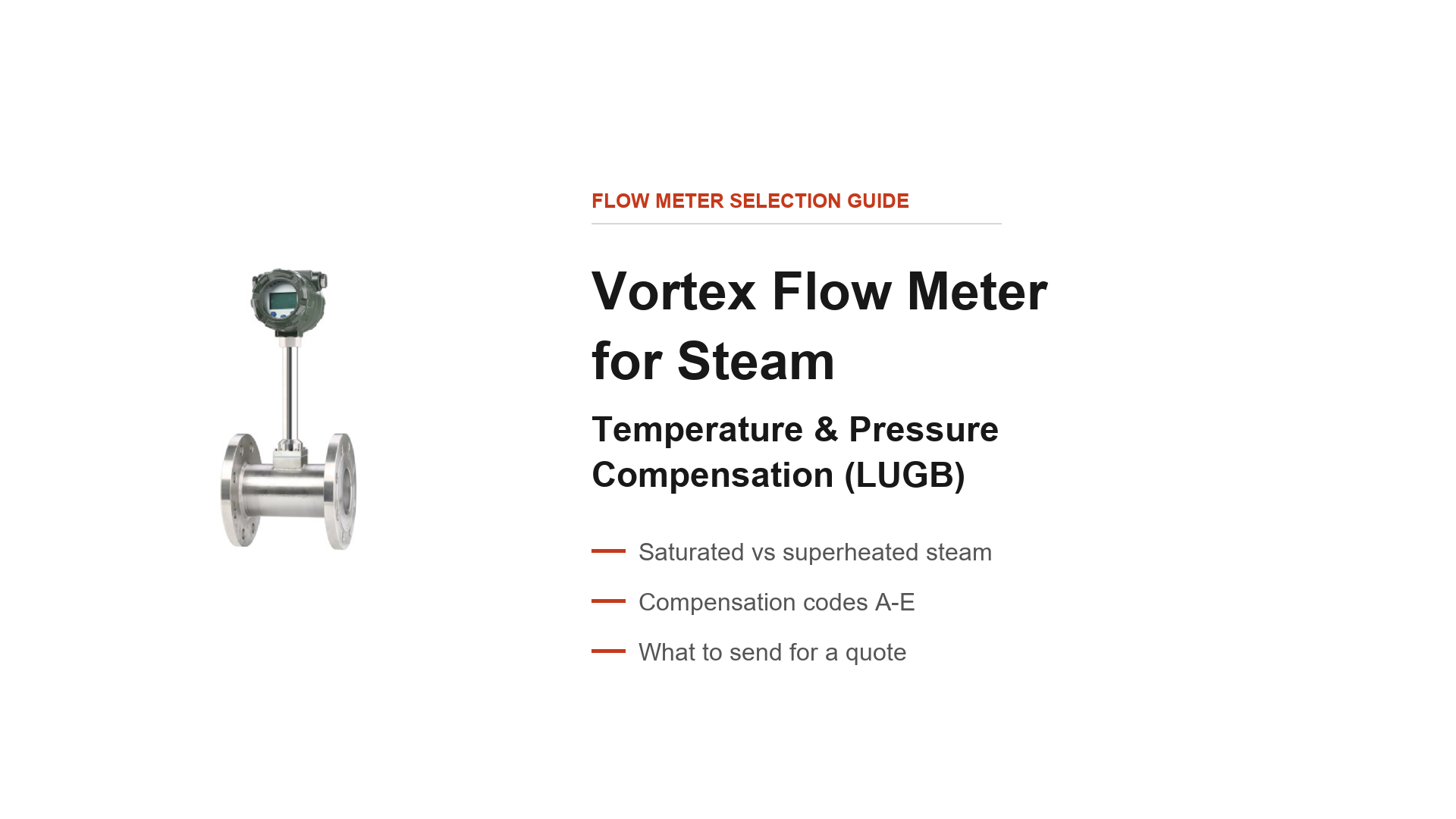
A vortex flow meter measures the frequency of vortices shed from a bluff body in the flow; that frequency is proportional to the flow velocity, so the meter reads working-condition volume flow (for example m³/h at the actual line pressure and temperature). A standard flanged LUGB unit is shown on the LUGB flanged vortex flow meter page.
Steam, however, changes density strongly with pressure and temperature. As the steam conditions change, the same volume carries a different mass. If a quotation needs kg/h or t/h, the volume reading must be converted using the steam density at the measuring conditions — that conversion is what "temperature and pressure compensation" means in practice. Without it, the meter still measures volume correctly; it simply cannot convert that volume to mass by itself.
So the first question for any steam application is not "which meter", but:
Do you need to report steam as mass (kg/h), or as working-condition volume?
- Working-condition volume only → compensation may not be required.
- Mass flow → the reading must be converted to mass, and how that conversion is done depends on the steam state.
Saturated vs superheated steam
These are the two steam states that drive the compensation decision.
Saturated steam is in equilibrium: for a given pressure there is exactly one temperature (and vice versa). Because temperature and pressure are not independent, for dry saturated steam it is often sufficient to compensate for one parameter to determine density — either temperature or pressure, depending on what is available and most stable at the site. This single-parameter approach assumes dry saturated steam. If the steam carries condensate (wet steam), a single temperature or single pressure reading does not by itself give reliable mass flow, because the actual wetness is not captured; wet-steam lines need the moisture condition assessed and the configuration confirmed before a mass-flow figure is relied on.
Superheated steam has been heated above its saturation temperature at the same pressure. Temperature and pressure now vary independently, and density depends on both. Converting to mass flow therefore normally requires both temperature and pressure.
Neither state is "better" — they simply require different treatment. The practical rule for selection:
Steam state | Are temperature & pressure linked? | Typical compensation need |
|---|---|---|
Dry saturated steam | Yes (one determines the other) | Single parameter (temperature or pressure) is usually enough |
Wet saturated steam (with condensate) | Yes, but moisture is not captured by one reading | Assess the moisture condition; confirm the configuration before relying on a mass figure |
Superheated steam | No (independent) | Both temperature and pressure |
Steam where only working-condition volume is required | — | No density compensation required |
How the LUGB model code expresses steam selection
LUGB is configured through a model code. Two fields in that code answer the selection questions above directly, so a buyer and a supplier can write the same configuration down unambiguously.
C — measured medium
Code | Medium |
|---|---|
1 | Liquid |
2 | Gas |
3 | Saturated steam |
4 | Superheated steam |
5 | Hot water |
E — compensation method
Code | Compensation |
|---|---|
A | None |
B | Temperature |
C | Pressure |
D | Temperature + pressure, integrated |
E | Temperature + pressure, split |
Using these two fields, the compensation decision becomes a configuration: for example, dry saturated steam with a single-parameter compensation, or superheated steam with temperature and pressure (D or E).
Availability note. The model code describes the available options; it does not mean that every combination of size, pressure rating, material and compensation is stocked or offered for every order. Specific combinations should be confirmed with the factory at the quotation stage.
Compensation codes D and E
When both temperature and pressure are required, the model code offers two entries: D — temperature and pressure compensation, integrated, and E — temperature and pressure compensation, split. These are the code meanings as listed in the catalog. The catalog does not describe how the "integrated" and "split" versions are physically arranged on this series, so the exact structure for a given model should be confirmed with the factory. The compensated version of this series is shown on the LUGB vortex flow meter with temperature and pressure compensation page.
If you are unsure which of the two applies to your line, include the meter location and the installation conditions with your enquiry, and the appropriate option can be confirmed against the available LUGB configurations.
LUGB steam selection at a glance
The table below collects the parameters that matter for steam selection. All values are the catalog values for the LUGB series; keep them as a set rather than mixing them with figures from other meter types.
Item | LUGB |
|---|---|
Medium | Gas, liquid, steam |
Flange-clamp sizes (DN) | 15, (20), 25, 32, 40, 50, 65, 80, 100, 125, 150, 200 |
Flange-connection sizes (DN) | 15, (20), 25, 32, 40, 50, 65, 80, 100, 125, 150, 200, 250, 300, (350) |
Sanitary-clamp sizes (DN) | 25, 32, 40, 50, 65, 80, 100 |
Medium temperature | Standard −25 °C to +80 °C; high temperature −25 °C to +250 °C or −25 °C to +300 °C |
Pressure rating | 1.6 MPa / 2.5 MPa / 4.0 MPa |
Accuracy | Liquid class 1; gas class 1.5 |
Protection | IP65 |
Body material | Stainless steel 304; converter housing aluminium alloy (a 316 body option is shown in the model code) |
Pressure rating is tied to size in the model code, so confirm the correct rating for your DN when configuring: the code maps 4.0 MPa to the smaller sizes (DN15–50), 2.5 MPa to DN65–100, and 1.6 MPa to DN125 and above.
Sizing a steam line (catalog steam flow range)
Unlike liquid and gas, steam flow range is not a single fixed table you can read off directly, because the volume a given mass of steam occupies depends on its pressure and temperature. The catalog therefore gives steam in dedicated tables: a saturated-steam flow-range table and a superheated-steam density table.
For a saturated-steam line, the catalog gives the flow range directly, as a table organised by nominal diameter (DN) and steam pressure, with a minimum and maximum flow for each DN at each pressure. In that table:
- pressure is in MPa;
- each DN column gives a minimum and a maximum flow;
- values shown in bold (within the boxed frame) are in t/h and the remaining values are in kg/h (as stated in the catalog note).
Because the source table mixes kg/h and t/h cell by cell across a wide pressure range (DN25 up to DN200), reproducing it here risks a unit error, so this guide does not reproduce the numeric cells. The table exists and is used directly to confirm the size for your steam pressure and flow — send those conditions and the size will be read from the full table.
Two rules from the same page make the table usable beyond its printed range:
- Above DN200: the catalog states that the steam flow range can be obtained by taking the gas flow range for the corresponding size and multiplying it by the steam density at the relevant pressure and temperature.
- For superheated steam: the catalog provides a separate superheated-steam density table for that density lookup, so the same approach applies.
Choosing the size. If the required steam flow falls outside the meter's measuring range for a given diameter — for example, the flow maps below the minimum or above the maximum for that DN — the correct response is to select a different nominal diameter (up or down) so the required flow sits inside the measuring range for that size. Provide the actual minimum, normal and maximum flows and the line conditions, and the suitable size can be confirmed.
Frequently asked questions
Does every steam application need temperature and pressure compensation? No. Compensation is needed when you must report steam as mass. If you only need working-condition volume flow, an uncompensated meter may be sufficient.
Is a single parameter enough for saturated steam? For dry saturated steam, often yes — temperature and pressure are linked, so compensating for one parameter is usually enough. If the steam is wet (carries condensate), a single reading does not capture the moisture, so the configuration should be confirmed before relying on a mass figure. For superheated steam, both temperature and pressure are normally required.
Do I have to buy the integrated dual-compensation model to get mass flow? Not necessarily. Mass flow requires the volume reading to be corrected for density; LUGB offers compensation configurations, but the correction can also be carried out by a confirmed external system. Choosing a compensation code is not a prerequisite for mass flow.
Is one compensation type more accurate than another? Not by itself. Accuracy depends on the meter's class and the installation; compensation corrects for density. The LUGB series lists liquid class 1 and gas class 1.5.
Can the same meter handle both saturated and superheated steam? The steam state is part of the configuration (medium code 3 or 4) and drives the compensation choice, so it should be specified at the quotation stage. Availability of a specific configuration is confirmed when ordering.
What output options are available? The model code lists output options: three-wire pulse, three-wire 4–20 mA, or RS485; a version with no signal output is also listed. Confirm the output you need when requesting a quotation.
What to send for a quotation
To configure an LUGB vortex meter for steam without repeated back-and-forth, send the following. This is the same set of inputs used to select any flow meter, adjusted for steam:
- Medium — steam, and whether it is saturated or superheated (this drives the compensation choice).
- Steam condition — for saturated steam, whether it is dry or carries condensate (wet steam); for superheated steam, the degree of superheat if known.
- What the reading must represent — mass flow (kg/h or t/h), or working-condition volume.
- Flow range — minimum, normal and maximum flow, with units.
- Pipe size and connection — nominal diameter, and whether the connection is flange-clamped, flanged, or sanitary clamp.
- Steam pressure — normal and maximum working pressure, and whether the value is gauge pressure or absolute pressure.
- Steam temperature — normal and maximum working temperature.
- Output / signal — pulse, 4–20 mA, or RS485, and whether a local display is required.
- Power supply — 24 VDC, or 12 VDC / battery (the 12 VDC and battery options apply to the smart-display head option).
- Installation conditions — indoor/outdoor, ambient conditions, straight pipe available upstream/downstream of the meter, available space, and any vibration or access limitations.
If you are not sure which compensation option is appropriate, include the installation conditions and a simple sketch; the configuration can be reviewed against the available LUGB options before quoting.