Oct 13, 2026Flow Meter Selection Guides
Integrated vs Remote Electromagnetic Flow Meter: Which Should You Choose?
Compare integrated and remote electromagnetic flow meters by access, environment, cabling and protection. Choose the right Yuanda LD configuration.
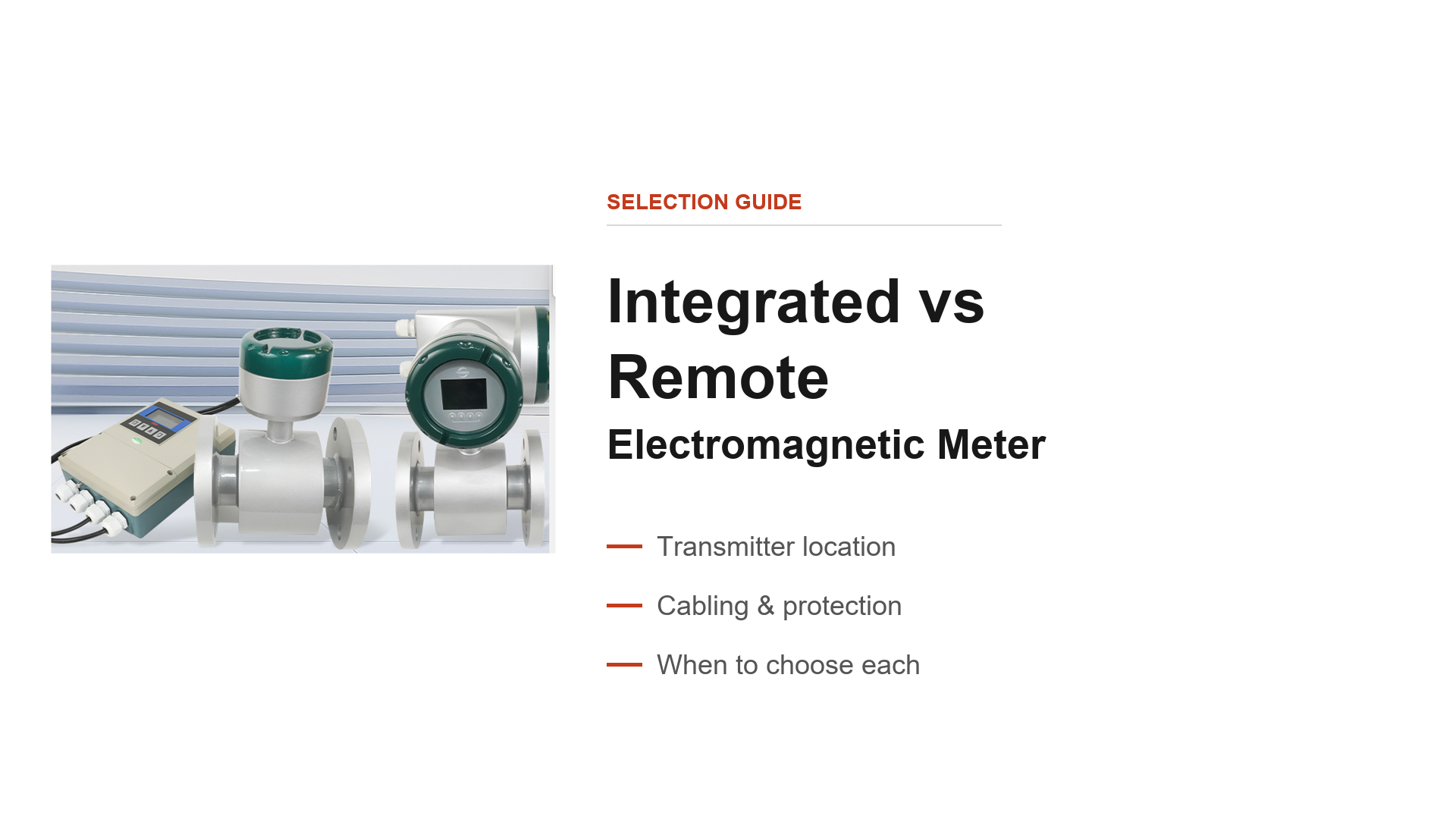
The choice between an integrated and a remote electromagnetic flow meter is mainly about where the transmitter needs to be installed. Both configurations measure the flow of electrically conductive liquids using the same underlying electromagnetic measurement principle. The difference is how the flow sensor and transmitter are arranged.
If the pipe is easy to access and the surrounding conditions are suitable for the electronics, an integrated meter is often the simpler installation. If the sensor must be installed in a pit, an exposed or difficult-to-access location, or somewhere the display would be inconvenient, a remote configuration may be more practical. The final selection still depends on the specific meter's environmental rating, cable requirements and available options.
What is the difference between integrated and remote mounting?
In an integrated (compact) electromagnetic flow meter, the transmitter is mounted directly on the flow sensor. The electronics and display, where fitted, are located at the pipe.
In a remote (split-type) electromagnetic flow meter, the sensor remains in the pipeline while the transmitter is installed separately, for example on a wall or support in a more accessible location. A dedicated sensor-to-transmitter cable connection is required. A remote meter is not automatically wireless.
Selection point | Integrated / compact type | Remote / split type |
|---|---|---|
Transmitter location | Mounted on the sensor at the pipe | Separate from the sensor |
Local access | Best when the pipe location is accessible | Useful when the display or electronics need a different location |
Interconnecting cable | No separate remote sensor-to-transmitter cable run | Requires compatible cable, correct termination and an approved cable length |
Installation work | Generally fewer separate mounting and cable tasks | Additional mounting, routing and cable protection to plan |
Wet or difficult locations | Suitability depends on the complete assembly's rating | May keep the transmitter away from the wet area, but the sensor, connection box and cable must still be suitably rated |
Typical reason to choose | Straightforward accessible installation | Better transmitter access or separation from demanding sensor locations |
Neither construction is inherently the more accurate choice. Accuracy depends on the selected meter's specification, flow conditions, installation and commissioning—not simply on whether the transmitter is separate.
Four site conditions that influence the choice
1. Where will the operator read or configure the meter?
For a water-treatment skid or accessible process line, the integrated version may be convenient because the transmitter stays with the sensor. Check that there is adequate space to view the display, reach the terminals and perform maintenance.
If the pipeline is in a below-grade chamber, an overhead location or behind equipment, a separate transmitter can put the interface where technicians can reach it. Specify the planned transmitter mounting position rather than assuming a remote type solves every access problem.
2. Will the sensor location be wet, flooded or exposed?
A remote arrangement can allow the transmitter to be installed outside a potentially wet chamber. This does not make every remote sensor submersible. Confirm the ingress-protection rating of the selected sensor, connection housing and cable entries, as well as the transmitter at its mounting location.
Yuanda's LD range lists different IP protection options across its configurations. Those ratings must be matched to the actual ordered model; they should not be presented as universal specifications for both designs.
3. How far apart will the sensor and transmitter be?
For a split-type meter, the route between the sensor and transmitter is part of the instrument selection. Confirm the distance, the manufacturer's permitted cable type and length, shielding and grounding instructions, and how the cable will be protected on site.
Do not assume that any ordinary signal cable will work or that a particular distance is permitted. Cable limits can depend on the meter design and the electrical conductivity of the liquid. The allowable distance for the selected Yuanda LD configuration must be confirmed before quotation.
4. Are process and maintenance conditions suitable?
The choice of mounting arrangement does not remove the need to verify liquid conductivity, minimum and maximum flow, pipe diameter, temperature, pressure, liner and electrode materials. These determine whether the electromagnetic meter and its wetted parts are suitable in the first place.
Electromagnetic meters require an electrically conductive liquid. They should not be selected for non-conductive oils or other media outside the specified conductivity range. Installation must also follow the meter's requirements for pipe filling, orientation, electrical grounding and flow conditions.
How this applies to Yuanda's LD electromagnetic flow meters
Yuanda has two relevant LD product configurations:
- Integrated LD Electromagnetic Flow Meter — a starting point where sensor and transmitter can be mounted together at an accessible process connection.
- Split Type LD Electromagnetic Flow Meter — a starting point when the transmitter needs to be located separately from the sensor.
The LD family catalog covers multiple nominal sizes, liner and electrode selections, and electrical output options. It also lists a minimum medium conductivity of 5 μS/cm for the family. These are series-level catalog details, not a promise that every size, output, enclosure rating or material is available in every integrated or split-type combination.
Before choosing a model, match the requested flow range and nominal diameter, medium and wetted materials, mounting conditions, output/power requirements and, for split versions, the actual sensor-to-transmitter distance. See the LD Electromagnetic Flow Meter product family for the available product paths.
Three common purchasing situations
Accessible equipment line: The process pipe is easy to reach, and the transmitter environment is within the instrument's limits. Start with the integrated LD version, then verify all process and electrical specifications.
Below-grade water chamber: The sensor is in a chamber where the display would be difficult to access. Consider the split-type LD, but specify the expected water exposure and request confirmation of the complete sensor and cable-entry protection requirements.
Plant monitoring system: The buyer needs flow data at a PLC or monitoring point. Either mounting style may be suitable. Decide the sensor/transmitter location first, then confirm the exact 4–20 mA, pulse/frequency or RS485 option and its applicability to the chosen model. An RS485 interface should not be assumed to support a particular protocol without confirmation.
What information should you send for a quotation?
Provide these details to avoid repeated specification questions:
- Liquid: Name, composition or concentration where relevant, and conductivity if known.
- Flow: Minimum, normal and maximum flow rates, with units.
- Pipe and process connection: Nominal diameter, connection standard and available installation space.
- Operating conditions: Normal and maximum medium temperature and pressure.
- Installation location: Indoor/outdoor, accessible/inaccessible, dry, washdown, or possible flooding.
- Mounting preference: Integrated or remote; for remote mounting, estimated sensor-to-transmitter cable route length and transmitter location.
- Electrical needs: Available power supply, signal/output requirements, and any known control-system protocol.
- Order requirements: Quantity and any model, documentation or packaging requirements.
If you are not certain whether integrated or remote mounting is appropriate, send the operating conditions and a simple installation sketch. Yuanda can review the requested configuration against the available LD options before quoting.
Frequently asked questions
Is a remote electromagnetic flow meter more accurate than an integrated one?
Not by virtue of its mounting style. Compare the specified accuracy and process requirements of the exact model. Cable selection, grounding and installation matter particularly for remote configurations.
Does remote mounting mean the flow sensor is waterproof?
No. The sensor, termination housing, cable entries and transmitter have their own protection requirements. Specify expected flooding or immersion and obtain confirmation of the supplied configuration's ratings.
Can I use any cable length between the sensor and transmitter?
No. The maximum permissible length and cable construction are model-dependent. Provide the route length when requesting a split-type LD meter.
Are integrated and remote LD meters suitable for every liquid?
No. Electromagnetic meters require conductive liquids, and the liner and electrode materials must be compatible with the medium and operating conditions. Confirm these details before selecting a model.
Next step: Compare the Integrated LD Electromagnetic Flow Meter and Split Type LD Electromagnetic Flow Meter, then use the website's Get a Quote action with the flow range, pipe size, medium, operating conditions and installation details.