Oct 17, 2026Flow Meter Selection Guides
Standard vs Corrosion-Resistant Glass Tube Rotameters: How to Choose
Standard, F or B? How LZB glass tube rotameter variants differ by wetted material, and how to choose one from medium, concentration, temperature and pressure.
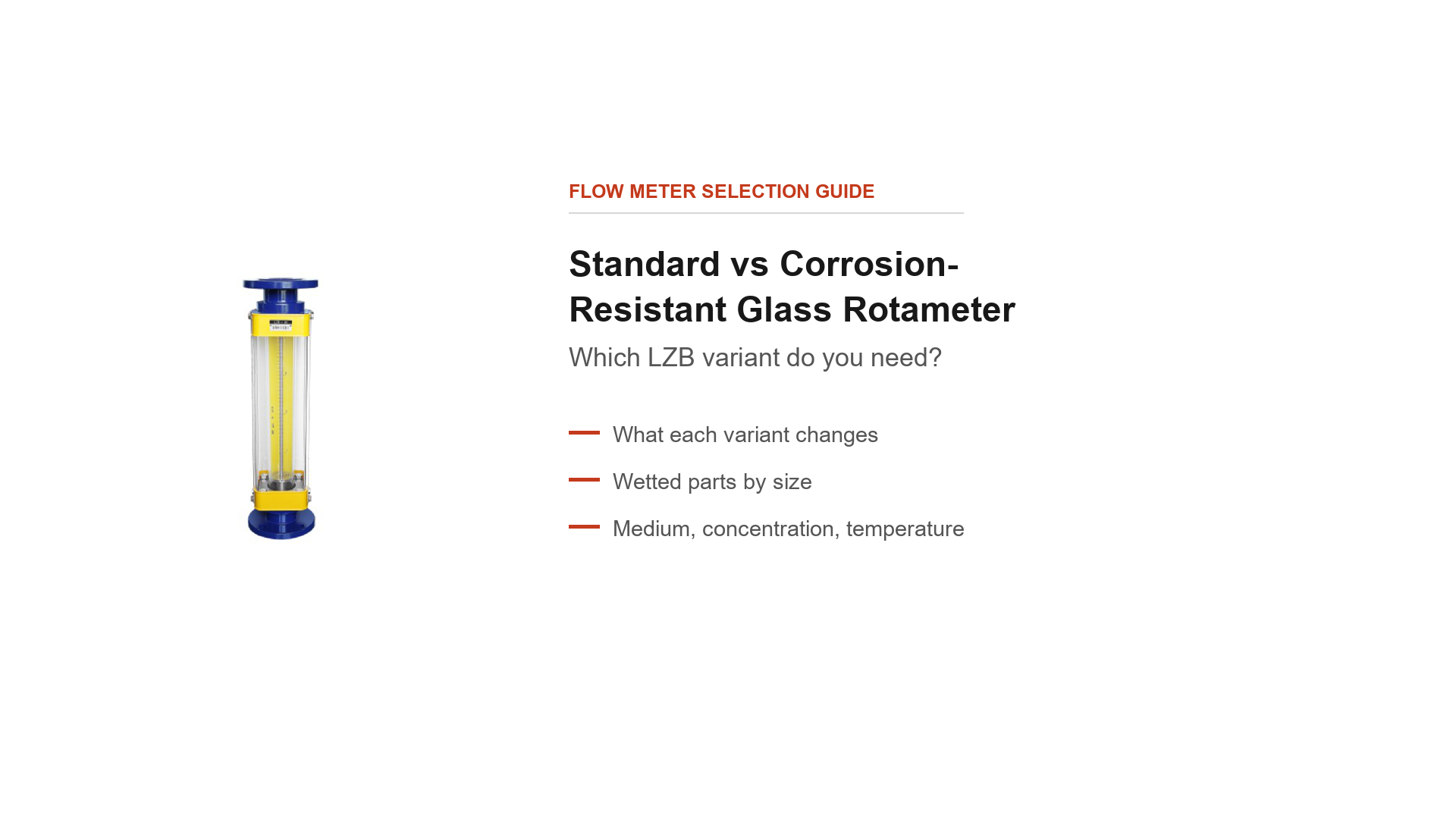
"Corrosion resistant" is not a single grade you can order like a size. On a glass tube rotameter it describes a set of wetted parts — the base or flange, the float, the guide rod, the stops, the seals and the tube — and those parts are not all made of the same material. Choosing between the standard and corrosion-resistant versions is therefore a question of which parts touch your medium, and what they are made of.
This guide sets out how the LZB glass tube rotameter variants actually differ, which materials contact the medium at each size, and how to decide between the standard, corrosion-resistant and stainless versions.
Two things up front, because they decide most selections:
- "Corrosion resistant" is a claim about specific materials under specific conditions. It does not mean a meter suits every acid, alkali or solvent. Medium, concentration and temperature must be confirmed for the actual selection.
- On this family the corrosion-resistant type is not an all-plastic meter. At the larger sizes it uses a flange lined with PTFE, so the lining — not the whole body — is the corrosion barrier.
- Hydrofluoric acid is excluded. The catalog names strong acids but excludes HF explicitly. Do not specify an LZB variant for hydrofluoric-acid service without checking with the factory.
Which variant do I need? (start here)
- Which size band? DN2–DN10 (small, hose-barb / M8×1 thread) or DN15–DN100 (flange). The two bands have different construction and ratings.
- Is any standard wetted material attacked by your medium? Check the standard-type tables below: base/flange, float and guide, stops, seal packing, glass.
- Only the flange/base is the weak point → the corrosion-resistant F version changes the base or flange to a PTFE barrier. See the LZB corrosion-resistant glass tube rotameter.
- The seals, the float or the guide is the weak point → F does not change those; raise them explicitly at quotation, or consider whether a glass tube meter is the right product at all.
- The relevant metal wetted parts must be stainless → B (304) or B0 (316) applies stainless steel to those metal wetted parts. Note that the glass tube and the seals remain non-metallic in these versions too, so the complete wetted-material list still has to be checked — B/B0 is not an all-metal wetted path.
- Both a stainless body and a PTFE barrier are required → B/F, DN15–DN100 only, made to order.
- If none of these constraints apply → the standard type is likely the appropriate starting point, provided the medium compatibility, flow range, pressure, temperature and connection requirements are all still confirmed for the specific model. That is the LZB standard glass tube rotameter.
What the variants are
Version | Model suffix | What differs (as catalogued) | Catalog's stated use |
|---|---|---|---|
Standard | none | Standard base/flange, float, guide and seals | Non-corrosive media |
Corrosion-resistant | F | DN2–10: PTFE base. DN15–100: flange lined with PTFE | Corrosive media |
All-stainless, 304 | B | 304 stainless steel (excluding the glass tube and seals) | Mildly corrosive service; resistant to corrosive gases in the environment |
All-stainless, 316 | B0 | 316 stainless steel (excluding the glass tube and seals). At DN≤10 made to order; at DN≥15 the support plate, gland and cover remain 304 | As B, where 316 is required |
Stainless + PTFE lined | B/F | 304 stainless flange lined with PTFE (DN15–DN100 only, made to order) | Strongly corrosive media |
Two limits worth noting: B/F is not a stock variant, and the F version has two different constructions depending on size — a PTFE base at DN2–DN10, and a PTFE-lined flange at DN15–DN100. The lining is the barrier at the larger sizes; the base metal behind it is not specified in a single consistent way in the catalog, so confirm the exact construction for your size at quotation.
Which parts actually touch the medium (standard type)
A rotameter has several wetted parts, and each can be a different material. The catalog gives them by size band for the standard type:
LZB-2 to LZB-10 (DN2–DN10)
Wetted part | Material |
|---|---|
Base | Chrome-plated brass and stainless steel |
Valve needle | Stainless steel |
Stops | PTFE |
Float | Agate ball or 304 stainless steel |
Seal packing | Acid- and alkali-resistant rubber (IV-1) |
LZB-15 to LZB-40 (DN15–DN40)
Wetted part | Material |
|---|---|
Flange | Cast iron lined with acid- and alkali-resistant rubber (IV-1) |
Stops | PTFE |
Float and guide rod | 304 stainless steel |
Seal packing | Acid- and alkali-resistant rubber (IV-1) |
LZB-50 to LZB-100 (DN50–DN100)
Wetted part | Material |
|---|---|
Flange | Cast iron with amino baking enamel inside (a coating, not a solid material) |
Stops | Cast iron with amino baking enamel inside |
Float and guide rod | 304 stainless steel |
Seal packing | Acid- and alkali-resistant rubber (IV-1) |
IV-1 is the catalog's designation for its acid- and alkali-resistant rubber.
The glass tube is borosilicate glass in every size and version — treat it as a constant when comparing variants. The differences between standard and corrosion-resistant sit in the metal and elastomer parts around it.
If your medium attacks the flange liner, the seal packing, or the 304 float and guide, the standard type is not suitable — even though the glass itself may be fine.
What the F version does and does not change. The catalog specifies F as a PTFE base (DN2–10) or a PTFE-lined flange (DN15–100). It does not state that F changes the float, guide rod, stops or seal packing. Do not assume it does: confirm those parts for the specific model at quotation.
What glass itself limits
The tube is borosilicate glass in every version. It is still glass: it sets a temperature boundary, and it is not suitable for every medium. The catalog's corrosion-resistant scope is strong acids (excluding hydrofluoric acid), strong alkalis, oxidising agents, strong oxidising acids and organic solvents — the HF exclusion applies to the glass tube in every variant, not only to F.
Borosilicate is the more chemically resistant common glass, but that is not a compatibility guarantee for a specific chemical at a specific concentration and temperature.
Sizes, pressure and temperature
Item | LZB-15 … LZB-100 |
|---|---|
Nominal sizes | DN15, DN25, DN40, DN50, DN80, DN100 |
Connection | Flange |
Pressure rating | Confirm for the specific model and configuration — see pressure note |
Medium temperature | 0 to +100 °C |
Accuracy (standard) | ±2.5% at LZB-15; ±1.5% at LZB-25 to LZB-100 |
Accuracy (F) | ±4% at LZB-15F; ±2.5% at the other sizes |
Range ratio | 1:10 at LZB-15/25/40/50; LZB-80 is listed as 1:10 and 1:5; LZB-100 as 1:5 |
Pressure rating is not published here as a fixed value. The pressure rating must be confirmed for the specific model and configuration at quotation. (Two pages of the catalog state different figures for this range; that discrepancy is recorded in the internal fact audit and is not resolved in this article. Do not take any pressure figure in this guide as a confirmed rating.)
Small sizes are a separate group with their own rating: DN2–DN10, PN1.0 MPa, 0 to +100 °C, hose-barb fittings at LZB-4/6/10, M8×1 external thread at LZB-2/3. Do not mix these figures with the DN15–DN100 flange figures above.
Frequently asked questions
What is the difference between F and B? F changes the base or flange to a PTFE barrier; B is an all-stainless 304 construction (excluding the glass tube and seals). They address different media and environments.
Does B mean everything is stainless? No. The glass tube and the seals are excluded from the stainless construction. No LZB variant is a "no wetted non-metal parts" meter — if that is a requirement, it must be raised explicitly.
Can I use the corrosion-resistant type with any acid? No. Hydrofluoric acid is explicitly excluded, and suitability otherwise depends on medium, concentration and temperature.
What to send for a quotation
- Medium — the chemical or fluid, and its concentration where relevant.
- Operating temperature — normal and maximum.
- Flow range — minimum, normal and maximum, with units, and whether the service is liquid or gas. For gas or viscous liquids, include density/specific gravity and viscosity.
- Pipe size and flange details — nominal size, flange standard (DIN / ANSI / JIS) and pressure class.
- Working pressure — normal and maximum.
- Variant constraint — whether standard, F, B, B0 or B/F is required, and why (for example: no elastomer in contact, no painted iron in contact, PTFE barrier required).
- Environment — whether the surrounding atmosphere is corrosive, which affects the B/B0 choice.
- Prohibited wetted materials — any material your process forbids (for example copper alloys, cast iron, or a specific elastomer).
- Required accuracy / scale — if your process specifies one.
If your process specification lists prohibited materials, send it: the standard-type tables above can be checked against it directly, and the F/B/B0 parts can then be confirmed to match.