Oct 26, 2026Flow Meter Selection Guides
Metal Tube Rotameter Selection: Local Indication vs 4–20 mA Output
LZZH reads flow locally with no power supply; LZDH adds a two-wire 4–20 mA output for PLC and DCS monitoring. How to choose and specify the right LZ configuration.
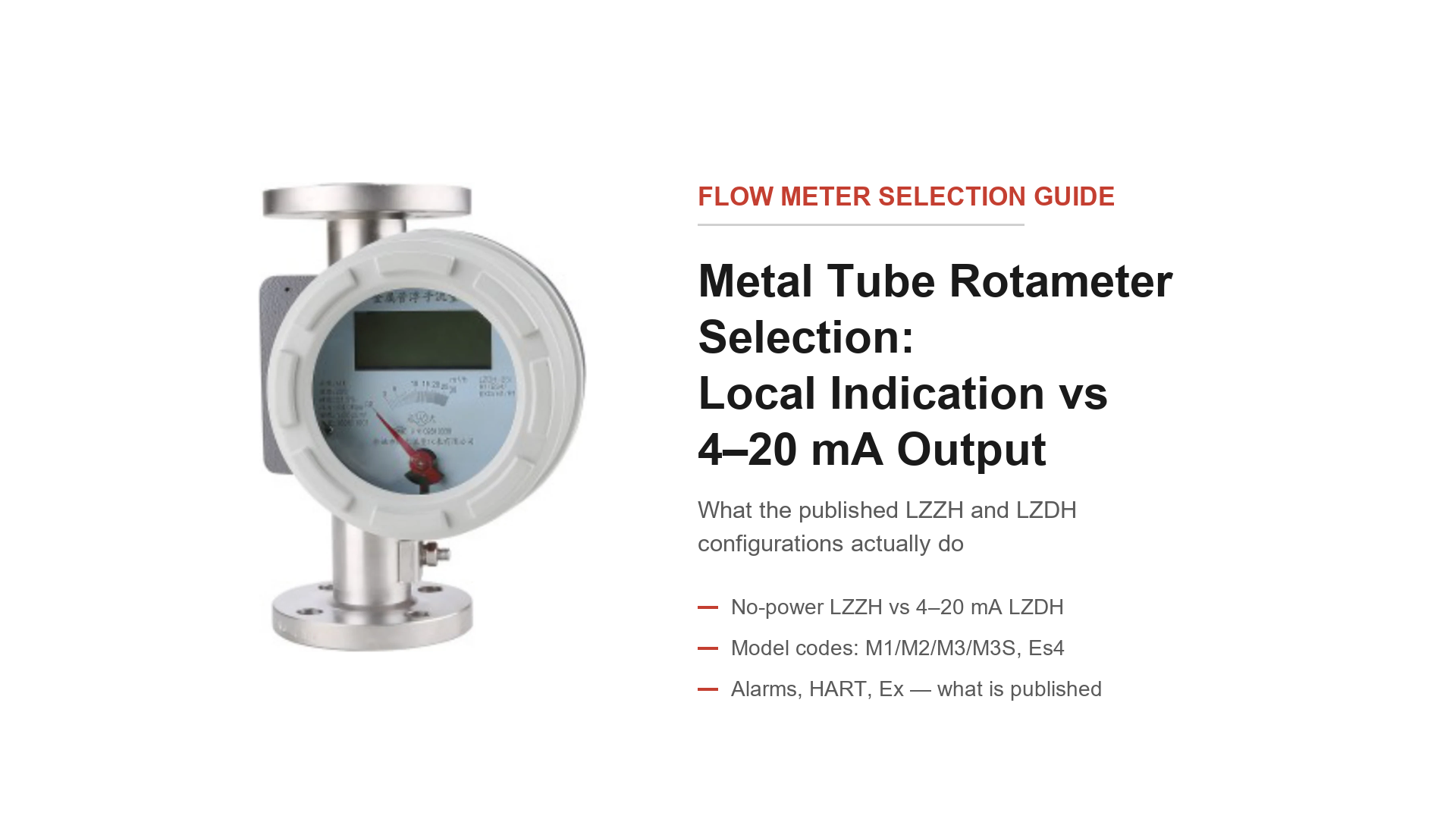
A metal tube rotameter is usually the answer when the liquid or gas is opaque, hot, pressurised or simply too aggressive for a glass tube. The buying question that follows is more practical: does this meter only need to be read on site, or does the control room need to see the flow too?
Yuanda's LZ family answers that question with two configurations built on the same measuring tube: the LZZH, which indicates flow locally and needs no power supply at all, and the LZDH, which adds a two-wire 4–20 mA output for PLC and DCS monitoring while keeping the local display. This guide explains what each configuration actually does according to the published catalog, what the model code letters mean when you specify one, and where the honest limits of the published documentation sit.
If you are still deciding between metering technologies, start with How to Select the Right Flow Meter for Your Application. This article stays inside the LZ metal tube family and its display and output options.
When Is Local Indication Enough?
The LZZH is the configuration for installations where a person can read the meter. The published specification is unusually clear on this point: power supply — none; display — pointer indication; output signal — none. There is no transmitter to wire, no loop to commission and no power failure that can take the reading away, because the pointer reading does not depend on electricity.
Local indication is enough more often than buyers expect. Sight glasses on a skid, cooling-water branches, dosing lines, compressor cooling loops, purge lines and sampling circuits all have someone standing next to them. If the flow value is acted on by an operator — open a valve, adjust a rotameter-coupled pump, confirm a process step — a pointer on a scale is faster to read and cheaper to own than a wired signal.
Two practical notes matter at this decision point. First, the reading is mechanically coupled: a magnet in the float drives the indicator pointer non-contactlessly, with no electrical supply involved anywhere in the chain. Second, "no power supply" is a feature worth stating explicitly in a specification, because it removes an entire class of commissioning problems — but it also means there is no electrical signal to send anywhere. If nobody walks past the meter, local indication is the wrong choice, not a bargain.
When Do You Need 4–20 mA Transmission?
The LZDH is the same variable-area measurement with an electric remote transmission added. Its published rows read: power supply — DC 24 V; display — pointer indication with an LCD showing instantaneous and accumulated flow; output signal — two-wire 4–20 mA. One meter, three simultaneous views of the flow: the pointer scale at the pipe, the LCD at eye level, and the analog signal in the control room.
Choose transmission when the meter's value has to reach a system. Typical cases: the line runs in an area operators visit rarely; the flow is one of several variables a PLC uses for interlocks or batch sequencing; production reporting needs the value whether or not anyone is at the panel; or management wants flow history from the DCS historian. In all of these, the local pointer and LCD stay useful — they are the first thing to check during a site walk, and the LCD reading depends on the loop being powered.
One term in that specification deserves care. Two-wire 4–20 mA means the same pair of conductors carries the signal and powers the transmitter, and the catalog's published supply for the LZDH is DC 24 V. Whether that loop power comes from the PLC/DCS analog input card or from a separate 24 V supply is a property of your control cabinet, not of the meter — and it has to be confirmed rather than assumed, because both arrangements exist in the field. State it explicitly in the enquiry, then confirm the actual terminal arrangement and electrical compatibility of the receiving channel with the factory before wiring. This article deliberately does not publish loop resistance, supply tolerance or a wiring diagram for that reason: those belong to the confirmed configuration, not to a general guide.
LZZH vs LZDH: The Published Configuration Differences
Everything the catalog publishes about the two configurations, side by side. Only rows documented in the LZZH/LZDH specification table appear here:
Specification row | LZZH | LZDH |
|---|---|---|
Series letter (model code A) | ZH — orifice-plate float, local indication | DH — orifice-plate float, electric remote transmission with local indication |
Size range | DN15–150 | DN15–150 |
Accuracy | Class 2.5; class 1.0 (liquid) to special order | Class 2.5; class 1.0 (liquid) to special order |
Max working pressure | 1.6–4.0 MPa by size | 1.6–4.0 MPa by size |
Medium temperature | Normal type −40…+100 °C; high-temp type −80…+250 °C | Normal type −40…+100 °C; high-temp type −80…+250 °C |
Wetted materials | Tube 304/316, PTFE or F46 lining; float 304/316, PTFE/F46 | Same |
Protection / flameproof | IP65; Exd II BT4 | IP65; Exd II BT4 |
Power supply | None | DC 24 V |
Display | Pointer indication | Pointer indication + LCD instantaneous and accumulated flow |
Output signal | None | Two-wire 4–20 mA current |
The three bolded rows are the entire commercial difference. Everything else — the tube, the float, the flanges, the temperature and pressure envelope, the accuracy class — is published identically for both. That is why the choice compresses to one question: does the signal need to leave the meter? If yes, the LZDH and its 24 V supply follow; if no, the LZZH runs on nothing but the flow.
Note what the display row does and does not say. For the LZZH the published wording is "pointer indication" and nothing more: this guide makes no claim about what, if anything, an LZZH indicator shows numerically. For the LZDH the catalog explicitly adds "LCD instantaneous and accumulated flow". The two are not interchangeable statements about the same head, and any question about numeric display on a local-indication build belongs in the enquiry.
What the Yuanda Model Code Actually Means
A complete LZ order code encodes the configuration letter by letter, and each letter carries a published rule that limits combinations:
Code position | Options in the catalog | Published rules worth knowing |
|---|---|---|
A — series | ZH local indication; DH electric remote transmission with local indication | ZH ↔ LZZH-type build; DH ↔ LZDH-type build with Es4 transmission |
B — size | DN15, 25, 40, 50, 80, 100, 150 | No letter after the size = vertical basic type; S horizontal (DN15–100), L threaded (DN15–100), K clamp (DN15–100) |
C — tube material | R1 304; R0 316; F = PTFE or F46 lining | Lining applies to the vertical basic type of LZZH/LZDH only |
D — indicator | M1 square aluminium linear indicator; M2 rectangular aluminium linear indicator; M3 round aluminium linear indicator; M3S round cast-aluminium smart remote-transmission flameproof indicator | Housing shape and material only as published; which numeric features each head carries is not tabulated — confirm with the factory |
E — transmitter | Es4: 4–20 mA, two-wire, 24 VDC — corresponds to LZDH | The only published transmission option for the LZ family |
F — explosion protection | Exi intrinsic safety, Exib IIC T4, with LB987S safety barrier; Exd flameproof, Exd II B T4 | Exd can only be ordered with the M3S indicator |
G — medium state | A gas — for gas duty the catalog recommends the LZZH/LZDH series with a damper; L liquid | The catalog advises, and asks for the damper to be specified with the order |
H — range | State the measured range and units | Refers to the published flow-range table; special ranges to special order |
Three of those rules do most of the specification work. The mounting letters (S/L/K) are limited to DN15–100, so larger lines are flanged vertical as standard. The lining option is tied to the vertical basic type, so a horizontally mounted corrosive-duty line needs its chemistry confirmed rather than assumed. And the explosion-proof choice is not free-floating: intrinsic safety (Exi) comes with the documented LB987S safety barrier pairing, while flameproof (Exd) forces the M3S indicator — the order code cannot be assembled arbitrarily, which is exactly what the code system is there to prevent.
Alarm Output vs Continuous Transmission
Buyers coming from competitor catalogs often ask for "a rotameter with limit switches", so this boundary deserves its own section — because the honest answer has three parts.
First, the LZDH's published output is a continuous two-wire 4–20 mA signal, not a switching contact. Nothing in the LZZH/LZDH specification table or code table publishes an alarm or limit contact on the meter. If your alarm logic lives in a PLC or DCS, that is normally where it should be: the analog signal reaches the control system, and the high/low comparison is a configuration item in your control logic rather than a device in the field. That is standard control engineering and needs no special hardware from the meter — but note that it also means the alarm's integrity is only as good as the analog channel and the control program, so it is a monitoring arrangement rather than a certified safety interlock unless your system is engineered and assessed as one.
Second, Yuanda's catalog does document a separate alarm-switch product line — a bistable magnetic flow switch with high contacts X1–X4 and low contacts Y1–Y4, rated max DC24/AC24, 0.3 A, 1 VA, IP65 — and the catalog states that this flow alarm switch is used for upper and lower limit alarms on the LZT, LZS and LZB series. Those are the plastic-tube and glass-tube families. What the catalog does not publish is an alarm-switch option in the LZZH/LZDH code table, so that switch cannot simply be assumed available on an LZDH.
Third, therefore: if a standalone high/low flow switch is the actual requirement, treat it as a separate product question and raise it explicitly in the enquiry so the factory can confirm current availability and configuration rather than a salesperson defaulting to "yes". If continuous monitoring with alarms in the control system is the requirement, the LZDH plus your PLC logic is the published, supported path. Whether the M3S indicator can additionally carry limit contacts is not stated in the catalog and should be treated as a factory-confirmation item.
Power, Accuracy and Hazardous Areas: What to Confirm
The LZDH needs its DC 24 V loop supply, and the LZZH needs nothing — but power is only the first of the site conditions the catalog qualifies. Four more belong in every specification:
Accuracy. Both configurations are published at class 2.5, with class 1.0 available for liquids to special order. The catalog states the accuracy class but does not publish the reference basis behind it (the conditions under which the figure is guaranteed). If your process tolerances or acceptance tests depend on that basis, ask for it — the class alone is a published value, while the basis is a factory-confirmation item.
Pressure and size. The published pressure envelope is 1.6–4.0 MPa by size: the flanged dimension table shows 4.0 MPa for DN15–50 and 1.6 MPa for DN80–150, while the clamp-connected type is published at 2.5 MPa for DN15–50 and 1.6 MPa for DN80. A line spec written as "4 MPa rotameter" without a size attached is ambiguous by the catalog's own tables — quote the DN and the connection, and the rating follows from the published table.
Temperature. The standard type covers −40…+100 °C media; the high-temperature type extends to −80…+250 °C. Ambient conditions are published separately at −25…+65 °C. High-temperature is an order-code decision, not a field adjustment, so it belongs in the enquiry from the start.
Viscosity and medium state. The published viscosity limits are DN15 ≤ 5 mPa·s and DN25–150 ≤ 250 mPa·s. For gas duty the catalog recommends this series with a damper specified; a damper is the catalog's stated recommendation for gas rather than a universal rule, and the right choice for a specific gas line is worth confirming. On explosion protection, the published markings are Exd II B T4 flameproof and the Exi intrinsic-safety pairing with the LB987S barrier. Those are the catalog's own Ex markings: this article makes no claim of ATEX or IECEx certification, and none should be assumed — if your site requires a specific certification or a hazardous-area assessment for the installation, state it in the enquiry and have the factory confirm what documentation can be supplied.
Common Configuration Mistakes
These are the order-code errors the published rules make easy to catch before they reach the factory:
- Specifying an LZDH where there is no 24 V loop supply. The transmission row says DC 24 V, two-wire. Confirm whether your PLC/DCS analog input provides loop power or whether a separate 24 V supply is needed; if neither is available, the local-indication LZZH is the honest choice.
- Assuming one pressure rating across all sizes. 4.0 MPa stops at DN50 in the flanged table and at DN50 for the clamp type; DN80 upward is 1.6 MPa in both.
- Ordering "with alarms" into the LZ code. There is no alarm-switch letter in the LZZH/LZDH code table. Alarms are either your PLC's job on the 4–20 mA signal, or a different product line to be confirmed.
- Assuming HART by default. The catalog's working-principle text mentions a 4–20 mA signal / HART protocol, but the LZDH output row and the code table list only two-wire 4–20 mA. If your host system expects HART, put it in the enquiry as a question, not as an assumption.
- Putting the lined corrosion-resistant type on a horizontal line. The PTFE/F46 lining is published for the vertical basic type of LZZH/LZDH only; horizontal corrosive duty needs factory confirmation.
- Leaving the gas damper out of the order. The catalog recommends this series for gas duty and asks for the damper to be specified; omitting it risks an oscillating pointer and a reading nobody trusts.
- Exceeding the viscosity table. DN15 is limited to ≤5 mPa·s; DN25–150 to ≤250 mPa·s. Heavy, viscous media at small sizes fail this table before any flow-range check.
- Leaving the range blank. Code position H requires the measured range and units; a meter ordered without them cannot be matched to the published flow-range table, and the "closest standard range" guess is where accuracy complaints begin.
Common Buyer Questions
Can a metal tube rotameter work without external power? Yes — that is the published LZZH configuration: power supply "none", pointer indication, no output signal. The pointer is driven magnetically from the float and does not depend on electricity.
I need flow in the control room but also want to read the meter on site. Can one meter do both? Yes — that is exactly the published LZDH: pointer indication and an LCD with instantaneous and accumulated flow at the meter, plus a two-wire 4–20 mA signal to the control system, powered from DC 24 V. The LCD is an electronic display, so it depends on that loop supply; the pointer does not.
Does the meter totalize flow? The LZDH's LCD is published to show instantaneous and accumulated flow at the meter. No external pulse or totalizer output is listed in the published documentation, so if totalization must happen in a PLC or a separate batch recorder, say so in the enquiry for confirmation.
Does it come with alarm contacts? Not in the LZZH/LZDH code table — there is no alarm-switch code to order. In a monitored installation the high/low alarm is normally implemented from the 4–20 mA signal in your PLC/DCS, which is a monitoring function rather than a certified safety interlock. Yuanda's catalog documents alarm switches for the LZT, LZS and LZB series, not for this one; if a standalone switch is the real requirement, raise it in the enquiry and let the factory confirm the current offering.
Is HART supported? The catalog's principle description states that the configuration with LCD also "outputs a standard two-wire 4–20 mA signal / HART protocol", but the LZDH specification table and the model-code table list only two-wire 4–20 mA. HART is therefore not confirmed as a current orderable configuration — treat it as a question to the factory.
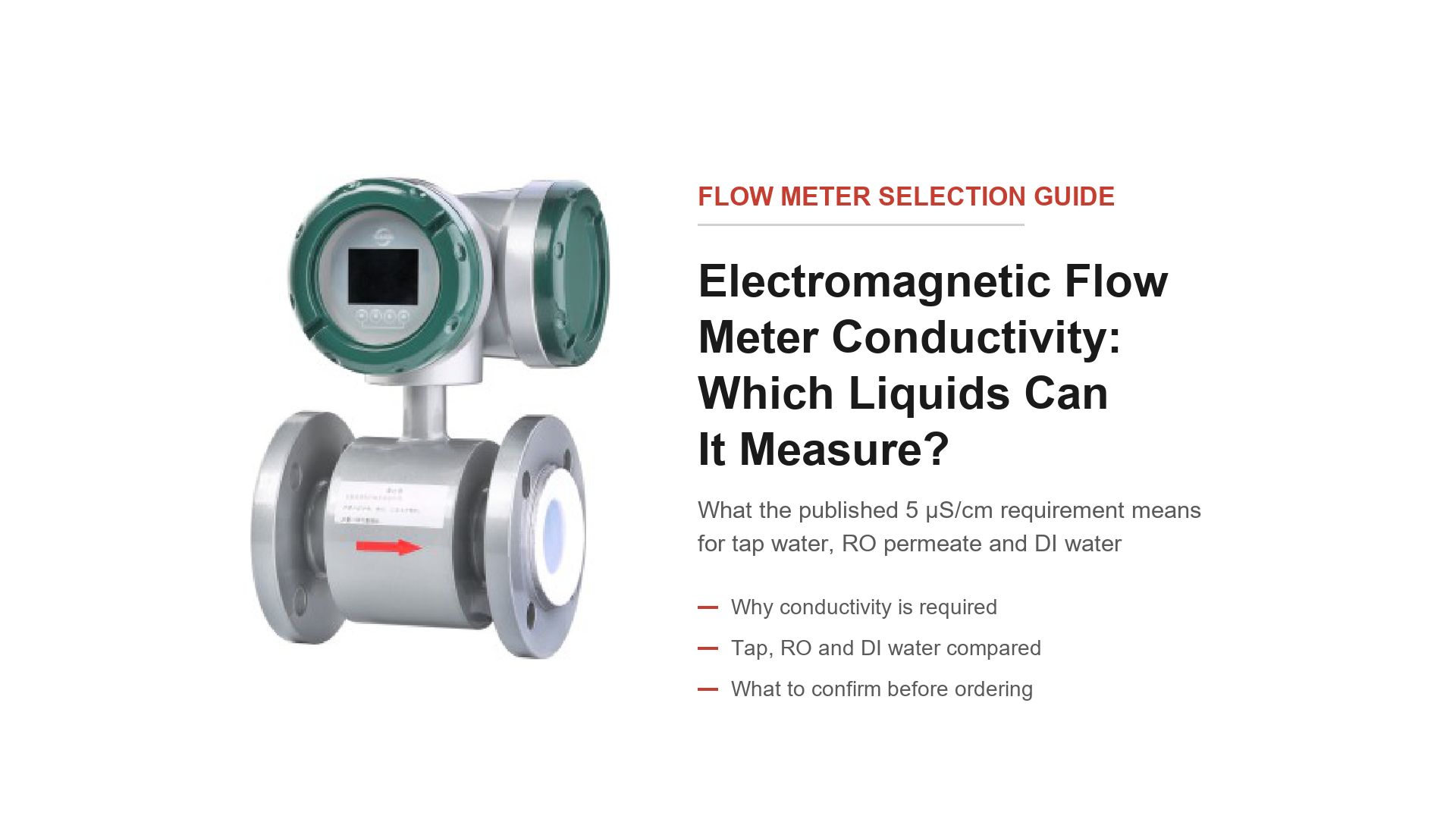
Does a metal tube rotameter need a conductive liquid? No. Variable-area meters couple the float position to the indicator magnetically — conductivity plays no part, which is why the family is positioned for opaque and corrosive media. The conductivity requirement you may have read about belongs to electromagnetic flow meters, a different measurement principle.
Requesting a Quote for an LZ Configuration
A quote request is the input to the factory's technical selection and quotation. The questions below are the ones that decide the configuration, and supplying them up front is what turns a generic enquiry into a specifiable configuration — though the final order code is still subject to the factory's confirmation of the points this catalog leaves open. Send it through Get a Quote.
RFQ item | Why it is needed |
|---|---|
Medium and state (liquid / gas) | Gas duty is routed to this series with a damper recommended; liquid sets the range basis |
Flow range — min / normal / max, with units | Matched against the published flow-range table (water 20 °C / air 101325 Pa, 20 °C); special ranges to special order |
Pipe size (DN) and line pressure | Size drives the published pressure rating: 4.0 MPa to DN50, 1.6 MPa from DN80 (flanged); 2.5 MPa to DN50 clamp |
Connection and orientation | Flanged vertical basic type, or S horizontal / L threaded / K clamp (DN15–100 only) |
Display requirement | Pointer only (LZZH) or pointer + LCD instantaneous/accumulated (LZDH) |
Output requirement | None, or two-wire 4–20 mA; state whether the PLC/DCS analog input supplies loop power or a separate 24 V supply is used |
Alarm or totalization expectation | Alarm switches are not in the LZ code table; state the real need so the factory confirms the route |
Medium temperature | Normal type −40…+100 °C; high-temperature type to −80…+250 °C by order code |
Viscosity | Published limits: DN15 ≤5 mPa·s; DN25–150 ≤250 mPa·s |
Hazardous-area requirement | Exd II B T4 (M3S indicator) or Exi Exib IIC T4 with LB987S barrier; state if a specific certification or area assessment is required |
Lining requirement | PTFE/F46 lining applies to the vertical basic type only |
The LZ metal tube rotameter family covers the configurations above — including the M1 local-indication build and the M2 local-indication build, the LZDH 4–20 mA transmission model, and the compact LZZX micro-flow meter for very small flows. An enquiry with these eleven lines gives the factory what it needs to select and quote the duty — and to flag honestly, before the order, anything the catalog does not publish.