Flow Meter Selection Guides
Plastic vs Glass vs Metal Rotameters: How to Choose
Acrylic, plastic tube, glass tube and metal tube rotameters solve different problems. A family-level selection guide for OEM builders, distributors and plant buyers.
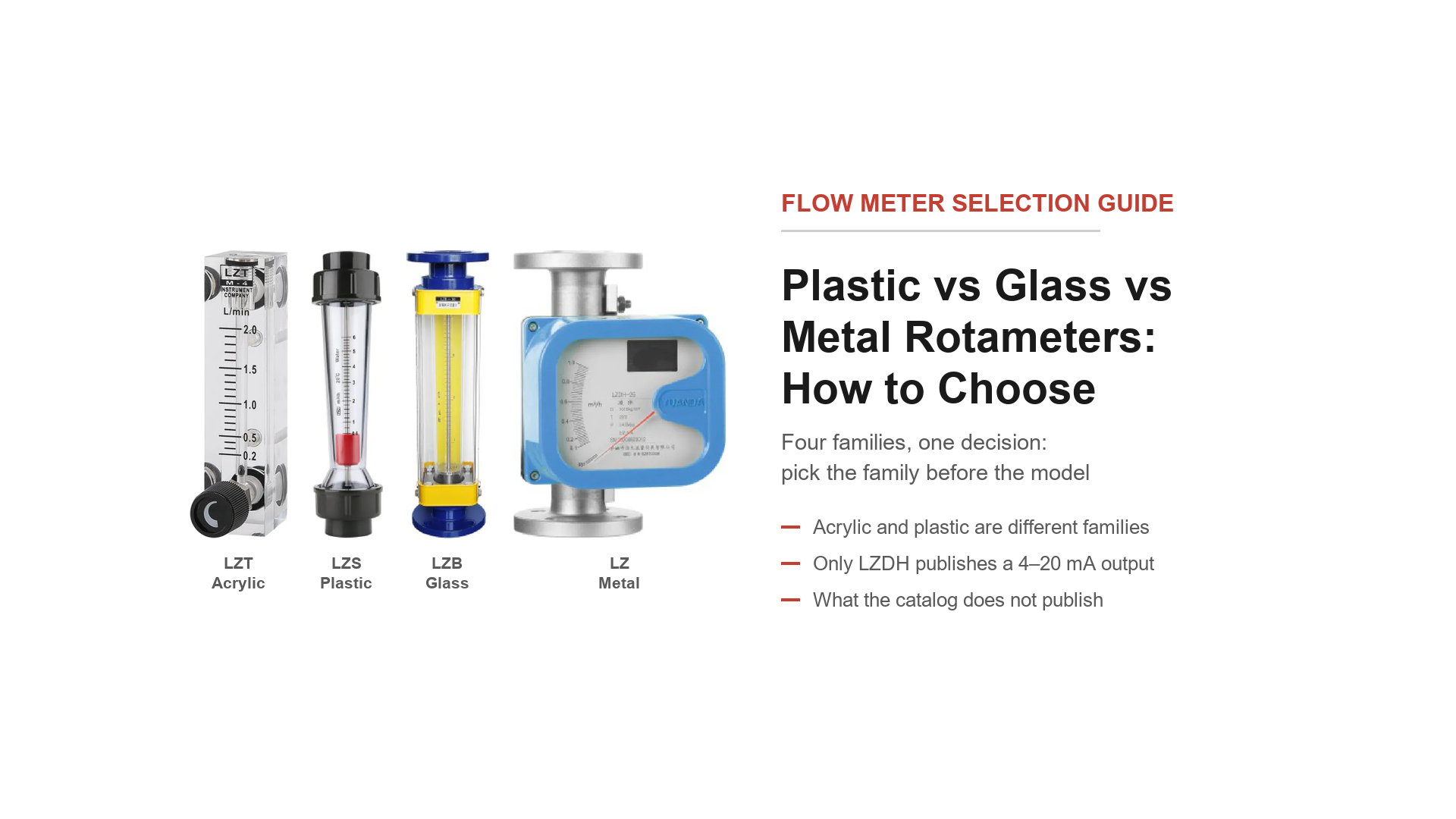
Most rotameter buying mistakes are made before anyone compares a model number. The buyer has a flow to measure, opens three catalogs, sees four tube materials and picks whichever page looks closest — and only later discovers the tube material does not match the medium, the connection does not match the pipe, or the family never offered the output the control room needed.
This guide is about that first decision: which of Yuanda's four rotameter families belongs on your application. It does not re-teach what acrylic or glass is, and it does not reproduce the model-level tables you will find in the guides that cover each family in depth. It answers one question — plastic, acrylic, glass or metal — and then tells you what still has to be confirmed before you ask for a price.
Two naming points before anything else, because they cause real ordering errors:
Acrylic and plastic tube are two different Yuanda families. The LZT series has an acrylic (organic glass) tube. The LZS series has an AS plastic tube with PVC fittings and ABS floats. They are not interchangeable names for "plastic rotameter", and they do not publish the same pressure or temperature limits.
The family name does not fix the mounting. Most LZT models are panel meters, but the LZT-G is an inline (pipeline-connection) meter — so "LZT" alone is not a mounting specification. Equally, not every LZ metal tube meter carries an output signal. Those details live at model level and are flagged as they come up.
Quick Selection: Which Rotameter Family Fits Your Application?
Four questions, in this order, resolve most family choices:
1. Can you see the tube? If the installation is indoors, the medium is clear, and someone walks past the meter, a transparent tube (LZT acrylic, LZS plastic, LZB glass) lets the operator see the float and the fluid at a glance. If the line must be opaque, the sight glass would be difficult to monitor in your installation, or the medium attacks the transparent polymers used in the LZT and LZS tubes, then the metal tube family becomes the candidate worth examining first. Whether a transparent tube suits a long outdoor installation is a question about that specific product, not a family-level rule.
2. Does the tube have to resist the medium? This is where family differences become specific rather than stylistic. LZB glass tube has five named material classes, and only the corrosion-resistant ones (F, B0, B/F) address aggressive media — the standard class does not. LZS publishes PVC fittings, PE stops and ABS floats. LZ metal tube publishes 304/316 steel with an optional PTFE or F46 lining. "Corrosion-resistant rotameter" is not a family-level claim in any of them.
3. What does the pipe look like? LZS offers socket or threaded connections from ZG1/2" to ZG2" and NPT equivalents, plus flanged variants. LZB DN15–100 sizes use flanges; the smallest LZB-2 and LZB-3 bodies are published with a hose-barb connection on the catalog selection table but with an M8×1 external thread on the product page — a discrepancy to confirm for the exact model. LZT panel models use quick-connect (4T) or internal ZG1/4" (6T/8T). LZ metal tube uses GB/T 9115.1 flanges on the main series, while the LZZX micro-flow models use NPT threads. The connection frequently narrows the family before flow range is even discussed.
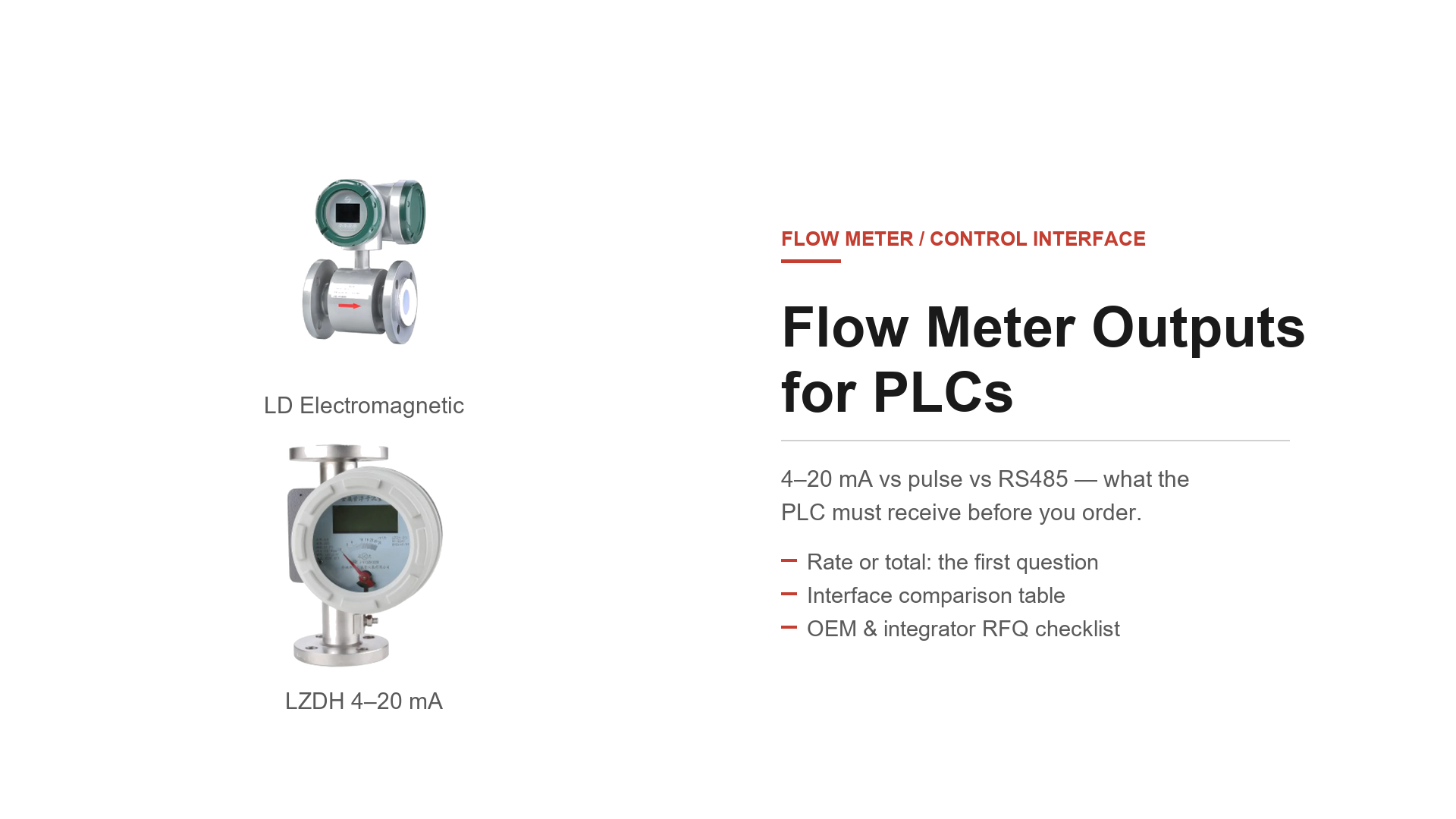
4. Does the value have to leave the meter, and in what form? A continuous analogue signal has one published option in this lineup: the LZ metal tube LZDH, two-wire 4–20 mA on DC 24 V. LZ M1/M2/M3 are local indication with no output. Separately, discrete limit/alarm switches are published for the LZT, LZS and LZB series — a switch tells you whether flow is above or below a set point, which is not the same as transmitting the flow value. If the control room needs the number itself, that narrows the field quickly; if a simple limit contact is enough, it does not.
The four families side by side, at the level a buyer actually decides on. Every row is drawn from published data for specific models — no family-wide maxima.
| LZT Acrylic | LZS Plastic Tube | LZB Glass Tube | LZ Metal Tube |
|---|---|---|---|---|
Representative mounting | Panel block (LZT-4T/6T/8T); inline on LZT-G | Inline, socket/threaded or flanged | Inline, hose barb or flange | Flange (M1/M2/M3, LZDH); NPT (LZZX) |
Main published connections | Quick-connect (4T); internal ZG1/4" (6T/8T); internal ZG1/2"–ZG1" (LZT-GL) | Socket or thread ZG1/2"–ZG2" / NPT1/2"–NPT2"; flange variants | Flange DN15–100; LZB-2/3 hose barb or M8×1 (see note) | GB/T 9115.1 flange; LZZX internal NPT1/4" / NPT3/8" |
Typical reason to pick it | Visible float in a compact panel meter, with a valve option | Visible flow in plastic pipework at low pressure | Visible flow with the widest choice of wetted-material classes | Opaque or pressurised duty, higher temperature, or a 4–20 mA signal |
Published pressure | Not published for the panel series | ≤0.6 MPa (socket/threaded) | PN1.0 MPa (LZB-2…10 F); PN0.6 MPa (DN15–50); PN0.4 MPa (DN80–100) | 1.6–4.0 MPa by size (main series) |
Published medium temperature | Not published for the panel series | 0–60 °C | 0–+100 °C | −40…+100 °C; high-temp type −80…+250 °C |
Key limit to confirm | Panel cut-out, pressure, temperature | Sub-family and seal material for your chemistry | Which material class (standard / F / B / B0 / B/F) matches the medium | Liner and float material; whether the output is actually needed |
Two notes on that table. The accuracy figures are deliberately excluded — they are published on different bases across families, so one row would invite a false comparison; they are discussed in the limits section instead. And the LZB-2/3 connection cell carries two published values, so treat it as a question for the factory rather than picking one.
Acrylic vs Plastic Tube vs Glass vs Metal
The four families, described by what the catalog publishes rather than by reputation.
LZT — acrylic. An acrylic (organic glass) variable-area meter for single-phase, non-pulsating liquid or gas. The panel sub-series (LZT-4T, 6T, 8T) is built as a rectangular block that mounts through a panel, with a regulating valve option and a published accuracy of ±4%. The same family also includes an inline model (LZT-G, catalogued as the LZT-GL pipeline-connection series), so "LZT" alone does not mean "panel".
LZS — plastic tube. A separate family with an AS cone tube, PVC socket and nut, PE stops and an ABS float on the socket/threaded type. Its published envelope on that type is 0–60 °C and ≤0.6 MPa — a genuinely different operating window from the acrylic series, and one of the few places in this lineup where a pressure and temperature figure is published at all. Connections run from ZG1/2" to ZG2" (and NPT equivalents), socket or threaded, with flanged and other sub-families alongside.
LZB — glass tube. A high-borosilicate glass cone tube is common to every variant; what changes is the wetted metal, lining and seal. Five classes are published: standard (no suffix), corrosion-resistant (F), 304 all-stainless (B), 316 all-stainless (B0), and stainless-plus-PTFE-lining (B/F). They are different material configurations rather than four grades of one thing — and each one has to be matched to your actual medium and concentration. Note in particular that the catalog describes even the 316 class (B0) as 316 stainless except the glass tube and sealing parts, so "316" does not mean every part is 316, and the 304 class (B) is not without corrosion capability of its own. The standard class uses chrome-plated brass and stainless internals with an alkali/acid-resistant rubber seal and, at DN15–100, cast-iron flanges — which is precisely why "glass tube rotameter" cannot be assumed to be the corrosion-resistant choice.
LZ — metal tube. A 304/316 stainless body with an optional PTFE or F46 lining, a published pressure envelope of 1.6–4.0 MPa by size, −40…+100 °C for the normal type and −80…+250 °C for the high-temperature type, IP65, and an Exd II BT4 flameproof option. Within the family, LZ M1/M2/M3 are local-indication meters with no output, while LZDH publishes a two-wire 4–20 mA signal on DC 24 V. Note also that "metal tube" does not mean every wetted part is metal: the lining and float options include PTFE and F46.
Flow Range and Connection Differences
Flow ranges are published separately for liquid and gas in every family, and the units change between families and even within one:
LZT panel — liquid in ml/min, LPH or GPH depending on the model; gas in L/min, and in m³/h on the 8T.
LZS — liquid in L/h and m³/h; separate gas columns.
LZB — from ml/min at the small end up to L/h and m³/h on larger sizes; separate liquid and gas columns.
LZ — water-based and air-based columns per DN.
A number without its column header is not a specification. The same figure can appear in two families calibrated for different media, and a wide-band scale resolves the low end worse than the middle.
Connection detail beyond the summary table above — the per-model published options, since these are what a quotation has to match:
LZT — quick-connect on the 4T; internal ZG1/4" on the 6T and 8T; internal ZG1/2", ZG3/4" and ZG1" across the LZT-15GL, 20GL and 25GL.
LZS — socket or thread from ZG1/2" to ZG2" and the NPT equivalents on the socket/threaded type; a flanged variant exists with its own published data.
LZB — flange on DN15–100. For LZB-2/3 the catalog selection table shows a hose barb while the product page states an M8×1 external thread: two published values, so confirm per model rather than assuming. LZB-4/6/10 are published with hose barbs, the diameter per model.
LZ metal tube — GB/T 9115.1 flange on the M1/M2/M3 and LZDH main series; the LZZX micro-flow models are published with internal NPT1/4" (LZZX-6) and NPT3/8" (LZZX-10), a different connection family entirely.
Pipe size follows from the same tables, and the ranges are not interchangeable between families: LZS runs DN15–65 on the socket/threaded type, LZB runs DN2–100, and the LZ metal tube main series spans DN15–150 with the LZZX covering micro sizes separately. For LZT, read the published flow ranges and connection data for the specific model rather than assuming a family-wide size span — the panel models, the inline LZT-G and the LZT-T series do not share one nominal-size list. If your line is unusually small or large, that alone may decide the family.
Pressure, Temperature and Wetted-Material Limits
This is the section that should stop a buyer from comparing families on a single datasheet line.
Published pressure values differ by family and, within a family, by size:
Family | Published pressure |
|---|---|
LZT panel series | Not published — confirm with the factory |
LZS socket/threaded | ≤0.6 MPa |
LZB-2/3/4/6/10 (F variants) | PN1.0 MPa |
LZB DN15–50 | PN0.6 MPa |
LZB DN80–100 | PN0.4 MPa |
LZ metal tube | 1.6–4.0 MPa by size |
Medium temperature:
Family | Published medium temperature |
|---|---|
LZT panel series | Not published — confirm with the factory |
LZS socket/threaded | 0–60 °C |
LZB | 0–+100 °C |
LZ metal tube | −40…+100 °C normal; −80…+250 °C high-temperature type |
The absence in the LZT row is not an oversight in this article. The catalog's panel pages do not publish a pressure or temperature rating, and the only LZT figures that appear anywhere belong to the oxygen sub-section with its own regulating valve. Borrowing a competitor's number for a specification of these meters is not a shortcut; it is an unverified claim.
Wetted materials and seals, by family:
Family | Tube | Key wetted parts published | Seal |
|---|---|---|---|
LZT acrylic | Acrylic | On the 4T/6T/8T panel series: regulating valve H brass or 304 SS; fitting standard chrome-plated brass | O-ring VMQ / FKM / NBR standard (panel series) |
LZS plastic | AS | Socket & nut PVC; stops PE; float ABS | "O" ring per type — confirm |
LZB standard | High-borosilicate glass | Chrome-plated brass + SS (DN2–10) or cast-iron flange (DN15–100); float agate ball or 304 SS | Alkali/acid-resistant rubber (IV–1) |
LZB corrosion-resistant F | High-borosilicate glass | PTFE base (DN2–10) or cast-iron flange with PTFE lining (DN15–100) | Per variant |
LZB all-stainless B / 316 B0 | High-borosilicate glass | 304 or 316 SS across flange, needle, float, guide rod, housing, bolts | Per variant |
LZ metal tube | 304/316 SS + optional PTFE/F46 lining | Float 304/316 or PTFE/F46 | O-ring VMQ / FKM / NBR |
Two consequences follow. First, "metal" is not a seal-material answer — a lined metal tube meter may present PTFE to the medium and still need an elastomer O-ring. Second, "glass" is not a corrosion answer — the glass is the same in all five LZB classes; the class suffix is what determines whether the wetted metal survives your chemistry.
Accuracy is published, but not on a common basis: LZT panel ±4%; LZS ±4%; LZB ±1.5% / ±2.5% / ±4% depending on size and variant; LZ class 2.5, with class 1.0 for liquids on special order. These figures should not be ranked against each other without confirming the reference basis for each — and the catalog does not state one common basis across families.
Local Indication vs Remote Signal Requirements
If an operator reads the meter, any family can serve. If a control system must read it, the choice collapses.
Published output capability:
LZ metal tube — LZDH: two-wire 4–20 mA, DC 24 V supply, local pointer plus LCD showing instantaneous and accumulated flow. Among the published rotameter data this is the continuous analogue signal option.
LZ metal tube — M1 / M2 / M3: local indication only, no output signal.
LZT, LZS, LZB: no continuous analogue output is published for their standard models. These series do have discrete limit/alarm switches — a bistable magnetic flow switch documented for the LZT, LZS and LZB series. A switch contact is a different thing from a continuous flow signal: it reports "above/below a set point", not the flow value. So the honest statement is that only LZDH publishes a continuous analogue output, while discrete switching is published for LZT/LZS/LZB.
Practical reading of that: a panel machine that only needs a human-readable flow is not served better by adding electronics it will never wire. A line that must report to a PLC or DCS has exactly one published route in this family set, and it comes with a 24 V supply requirement that belongs in the enquiry.
Three Practical OEM Procurement Scenarios
These are illustrative selections built from published data — not completed Yuanda customer projects.
A. Small-flow OEM machine, panel mount, local reading only. The buyer builds bench equipment with a front panel and needs to show an operator a flow of roughly 30–60 ml/min of water, with no control-system connection. First candidate: LZT acrylic panel model — the LZT-4T publishes liquid ranges in ml/min (6-60, 8-80, 10-100, 40-400), the panel block mounts through a front panel, and ±4% is published for the panel series. If the flow is the setting point on that branch, the T (with regulating valve) build puts the adjustment at the meter. Why not the others: For this combination of very low flow and panel mounting, the other families are not the first choice for the specified mounting arrangement rather than being technically incapable: LZS and LZB are inline products in their published configurations, and the LZ metal tube main series begins at larger flows. Which specific low-flow models could reach this band — for example within LZB small sizes or the LZZX micro-flow series — has to be checked model by model against the published range, connection and mounting data, and none of this is a statement about quality. Still to confirm: the panel cut-out drawing for the exact model, and the LZT panel-series pressure and temperature ratings, which are not published.
B. Water-treatment equipment pipework. The buyer assembles a treatment skid with 1" pipework, ambient-to-40 °C water, low line pressure, and wants a visible reading plus the option of a modest range of flows. First candidate: LZS plastic tube — published 0–60 °C and ≤0.6 MPa suits this duty, the socket/threaded type offers ZG1" connections, and the transparent AS tube shows the float and the water. Alternatively LZB glass tube where the medium requires the glass's chemical inertness or the higher published accuracy class. Why not the others: For this arrangement, LZT panel models are panel-mount devices and the LZT panel-series pressure and temperature ratings are unpublished, so they are not the first choice for an inline skid line until the factory confirms those figures. The LZ metal tube family is aimed at higher pressure classes than this example assumes, so it is worth considering only if the actual line pressure turns out to need it. Still to confirm: which LZS sub-family (socket/threaded vs flanged) matches the skid's actual pipe termination, the seal material for the specific water chemistry, and the LZS flange/E pressure and temperature ratings if a flanged build is chosen.
C. Industrial process line, opaque or aggressive medium, signal to the control room. The buyer has a 2" process line at elevated pressure and temperature, the medium is not something to put behind acrylic, and the DCS needs the flow value. First candidate: LZ metal tube, LZDH — published 1.6–4.0 MPa by size, −40…+100 °C normal (or −80…+250 °C high-temperature), and a two-wire 4–20 mA output, which is the continuous analogue option published in this rotameter lineup. Why not the others: The transparent-tube families are less suitable here because the medium is not one you would want behind acrylic or plastic, and because the LZT panel-series pressure and temperature ratings are unpublished. For LZB, the published ratings (PN0.6 MPa at DN15–50, PN0.4 MPa at DN80–100, 0–+100 °C) sit below the elevated duty this example assumes — but that is an illustration, not a measurement of your line: check your actual pressure and temperature against the specific size and variant. Still to confirm: the working pressure, temperature and size for the real line (the figures in this scenario are illustrative), the liner and float material against the actual chemistry, whether the Exd II BT4 option is needed and what that implies for the indicator choice, and the viscosity limits for the specific size.
Mistakes When Comparing Rotameter Families
Treating "plastic" as one family. LZT acrylic and LZS plastic tube publish different pressure, temperature and material data. A quotation that says "plastic rotameter" without a family is not yet a specification.
Assuming the family name fixes the mounting. Most LZT models are panel meters, but the LZT-G is an inline (pipeline-connection) model, so "LZT" alone does not tell you the mounting form.
Assuming metal tube means an output. LZ M1/M2/M3 publish no output signal. Only LZDH does.
Assuming metal means all-metal wetted. LZ publishes PTFE/F46 lining and PTFE/F46 float options, plus VMQ/FKM/NBR O-rings.
Reading the LZB class suffix as an all-or-nothing corrosion rating. F, B, B0 and B/F are different material configurations, not four grades of the same thing: even the 316 class (B0) is published with the glass tube and sealing parts unchanged, so the chemical suitability of each class has to be judged against your actual medium and concentration.
Assuming glass is corrosion-resistant. LZB has five material classes; only F, B0 and B/F address corrosion.
Lifting a family maximum onto a small size. LZ pressure falls from 4.0 MPa to 1.6 MPa as size grows, and LZB accuracy changes with size and variant. Quote the size and the variant, then read the number.
Using another supplier's pressure or temperature figure for LZT. None is published for the LZT panel series.
Ranking accuracy across families. ±1.5%, ±2.5% and ±4% appear in this lineup on different bases; the catalog does not publish a common reference.
Sizing at the very bottom of a published band. Where a model publishes a 1:10 range ratio, the low end carries a larger relative uncertainty; put normal flow toward the middle of the band rather than at its floor. Range ratios also differ between models (LZB publishes 1:10 at most sizes but 1:5 on the largest), so read the ratio for the model you are ordering.
Assuming a competitor's price or durability story maps onto these families. Nothing in the catalog supports a claim that one family is cheaper, more accurate overall, longer-lived or cheaper to maintain.
Frequently Asked Questions
What is the difference between acrylic and plastic tube rotameters? They are two different Yuanda families, not two words for one product. LZT uses an acrylic (organic glass) tube; LZS uses an AS cone tube with PVC socket and nut, PE stops and an ABS float. They publish different pressure and temperature figures — LZS socket/threaded states 0–60 °C and ≤0.6 MPa, while the LZT panel series publishes neither.
Which family suits a panel-mounted OEM machine? The LZT panel models (4T, 6T, 8T) are built as panel blocks with published ranges and a regulating-valve option. Note that LZT also includes an inline (G) model, so specify the panel variant explicitly.
Which family fits water treatment pipework? LZS plastic tube publishes a 0–60 °C, ≤0.6 MPa envelope with socket/threaded connections up to ZG2" that suits many treatment skids. LZB glass tube is the alternative where chemical inertness of the tube or a higher published accuracy class matters.
Can I get a 4–20 mA output on any rotameter family? Only LZDH publishes one — two-wire 4–20 mA on DC 24 V. LZ M1/M2/M3 have no output, and the LZT, LZS and LZB standard models publish none. The LZT alarm-switch variant is a discrete switch product, not a continuous signal.
Does a metal tube rotameter mean all wetted parts are metal? No. LZ publishes 304/316 steel with PTFE or F46 lining options, and PTFE/F46 float options, plus a choice of VMQ, FKM or NBR O-rings.
Are glass tube rotameters corrosion-resistant? Only the corrosion-resistant classes are. LZB publishes five material classes — standard, F, B, B0 and B/F — and the standard class uses chrome-plated brass internals and, at DN15–100, cast-iron flanges.
What pressure and temperature can the acrylic panel rotameters take? Not published in the catalog for the panel series. State your duty and have the factory confirm it; do not substitute another supplier's figures.
How do I know which size to order? Size follows from the published range tables for your medium, not from the pipe alone: pick the range whose band contains your normal flow comfortably above the bottom, then match the connection to your pipe. If normal flow sits at the very floor of the published band, consider the next range down.
OEM and Distributor RFQ Checklist
A request that carries these lines can be quoted as a configuration rather than a conversation:
Item | Why it decides the family |
|---|---|
Application / equipment type | Establishes panel, inline or pipeline mounting and the duty class |
Liquid or gas | Selects the correct published range column |
Medium and concentration where relevant | Drives tube material, lining and seal choice |
Minimum / normal / maximum flow, with units | Matches against the right family's range table |
Operating pressure and temperature | Rules families in or out; LZT needs factory confirmation |
Pipe size and connection | Often decides the family before range does |
Installation orientation | Panel block vs inline vs pipeline |
Local reading or electrical output | A continuous analogue signal requirement points to LZDH; a discrete limit switch is a different question (published for LZT/LZS/LZB) |
Wetted-material requirement | Lining, float and seal specification |
Initial order quantity | For quotation |
Estimated annual or repeat requirement | For planning — no published MOQ or lead-time policy should be assumed |
Drawings or documentation needed | Panel cut-out, installation drawing, certificates |
Send it through Get a Quote. Each family has its own page with the models and published data: Acrylic Rotameters, Plastic Tube Rotameters, Glass Tube Rotameters and Metal Tube Rotameters.
For model-level depth, the companion guides cover each family: acrylic selection, plastic tube connection types, standard vs corrosion-resistant glass tube, metal tube local vs 4–20 mA and LZT-4T vs 6T vs 8T. Representative models: LZT-6T, LZS socket/threaded, LZB standard, LZ M1 and LZDH.