Blog & Insights
Why Are Flow Meter Quotes So Different? What Buyers Should Compare Before Ordering
Comparing flow meter quotes? Check specifications, included documents, delivery terms, lead time and after-sales support before choosing a supplier.
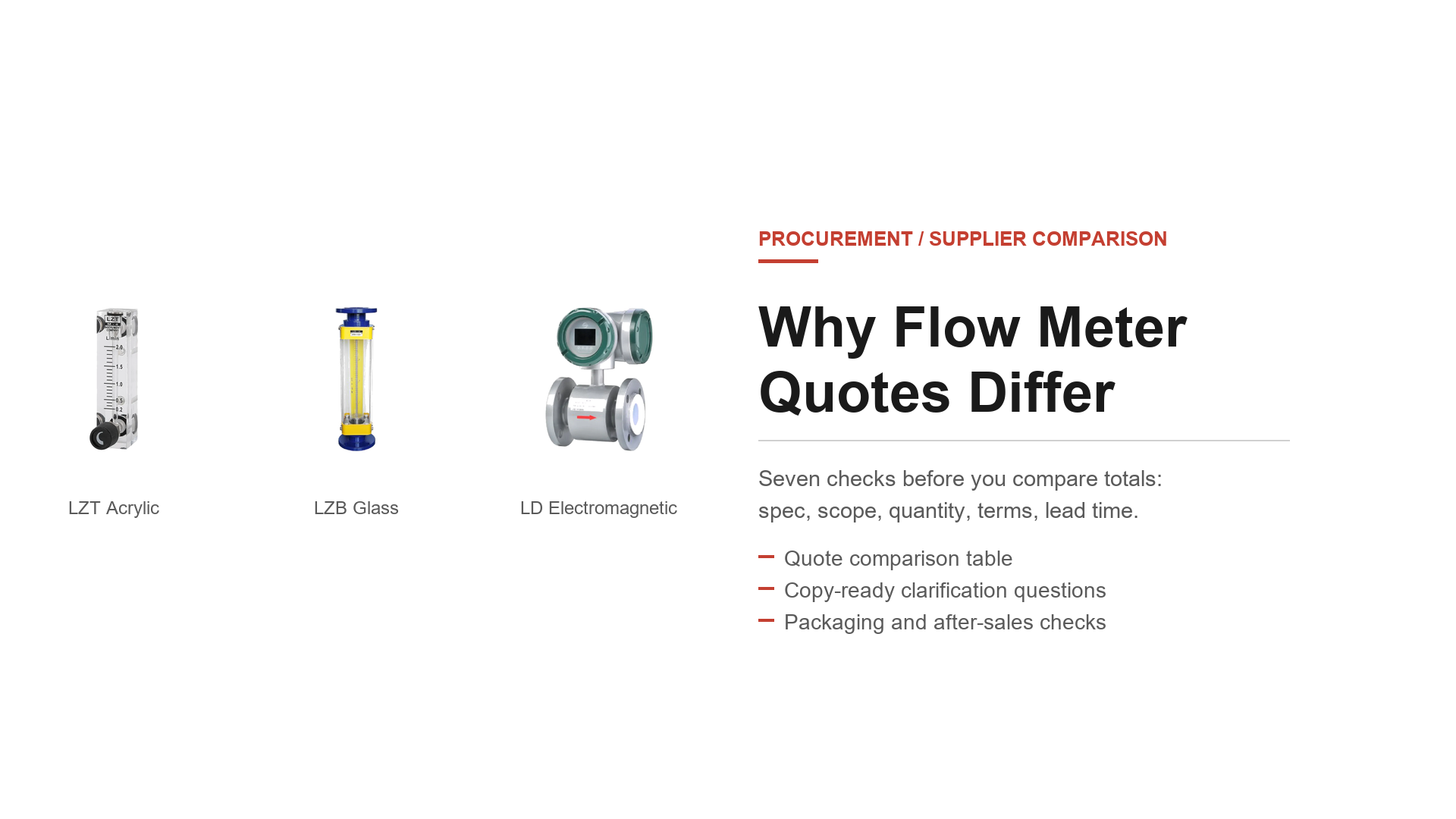
Send one flow meter enquiry to several suppliers and you may receive very different prices. Some of the difference is commercial pricing; some may come from different specifications, accessories, documentation or delivery terms. Before choosing a supplier, check what each price actually covers.
This is a practical way to compare flow meter quotations: establish a common specification, identify what is included, then ask each supplier to price the same requirement. A lower offer may still be the best choice — but only after you know what you are comparing.
The quote that looks complete and is not
A one-line offer — "flow meter, DN50, 4–20 mA, USD X" — may leave out the details needed to compare it with another. Depending on the technology, those details include wetted materials, accuracy class, connection standard, pressure rating, flow range, output configuration and documentation. Some affect cost; others determine whether the meter is suitable for the installation.
Compare technical suitability first, what is included second, and price third. If a specification is missing, ask for it before ranking the offers.
Check 1: is the specification identical?
Start with your application requirement, then check each quotation against it.
Put the offers side by side. Check these details wherever they apply:
Model and variant. A product family is not an exact order code. LZT-4T, LZT-6T and LZT-8T are distinct panel-mount models; a local-indication metal tube meter and an electric-transmission version also serve different requirements. "LZT" alone does not identify the same item as "LZT-6T".
Wetted materials. Depending on the meter, check the tube or liner, electrodes or float, seals and other relevant wetted parts. Not every type has every component. If an applicable material is unspecified, confirm it rather than assuming it matches another offer.
Accuracy class. If a family offers different accuracy classes, confirm which one is included. For example, the LW turbine family lists 0.5% and 1.0% versions by size and type; the exact quoted model matters.
Connection and standard. Confirm flange, thread or clamp connection, and the applicable dimensions or flange standard. Two DN50 meters may still need different pipe connections.
Flow range. Compare the quoted measuring range with the minimum, normal and maximum flow in your process. A matching DN alone does not establish a matching measurement range.
Output. Some Yuanda families offer options such as 4–20 mA, pulse or RS485, but the exact choice depends on the model and configuration. Confirm what the quote includes and whether it matches the PLC requirements; do not assume that all outputs can be used together.
Create one requirement sheet using your process data. Ask suppliers to mark any deviation explicitly. A different configuration may be a valid alternative, but label it as an alternative instead of treating it as an equivalent quote.
Check 2: what is inside the scope and what is not
Two quotes with the same specification can still differ by a wide margin on scope. The recurring items:
Scope item | Why it changes the comparison |
|---|---|
Calibration documentation | Whether a report or certificate is required, who issues it, and what it covers |
Factory test record | Which checks or reports are included, if any |
Documentation language | Datasheet, manual or wiring information in a usable language |
Drawings | Dimensional or installation drawings, if needed for approval |
Accessories | Gaskets, bolts, mating flanges, mounting brackets |
Spare parts | Availability and whether initial spares are included |
Packaging | Individual carton, foam, or export crate |
Freight and insurance | Which costs are included under the stated delivery terms |
Not every project needs every item. Decide which documents, accessories and services your project requires, then compare prices for that same scope. Otherwise a missing item may only become visible after the purchase order.
Check 3: quantity and how the price was built
The requested quantity can change the unit price and even the available configuration.
A price for one unit is not directly comparable with an offer conditional on fifty. Ask whether the rate assumes a minimum order quantity, a price tier or scheduled repeat purchases. If that condition does not match your order, request a price at your actual quantity.
For an OEM or distributor enquiry, it may help to request separate prices for the first order and a realistic repeat volume. Those figures should come from current written quotations, not assumptions.
Check 4: trade terms and what they cover
An identical meter can have different quoted prices because the delivery responsibilities are different.
For international purchases, ask for the full rule and named place or port — for example, "FCA [named place], Incoterms® 2020" — rather than "FOB price" or "delivered price" without details. Confirm which freight, export and insurance costs are included and where risk transfers. The ICC Incoterms® 2020 guidance explains these responsibilities. Payment terms and warranty are separate commercial matters; the Incoterms rule does not settle them.
Check 5: lead time and what it is measured from
Lead-time figures can start from different events and therefore appear more comparable than they are.
Ask when the clock starts: order confirmation, receipt of deposit, drawing approval or another agreed milestone. "Three weeks after drawing approval" is not the same commitment as "three weeks after purchase order." Check whether the schedule is indicative or confirmed, and whether it covers all units or the first shipment.
The comparison should use written lead times measured from the same agreed starting point.
Check 6: packaging and shipping protection
Packaging and shipping protection can differ even when the instrument specifications match.
Ask how the meter will be protected: individual carton, internal cushioning or export crate as appropriate. For flanged meters, check flange-face protection; for glass-tube meters, ask how the fragile tube is supported. If the packaging is not specified, ask before estimating shipping and damage risk.
Check 7: after-sales, spares and what happens after installation
A lower purchase price may not be better value if support or replacement parts are difficult to obtain.
Ask who handles a problem found during commissioning, what support is included, and how a claim is assessed. For relevant models, confirm availability of replacement seals, floats or other service parts. Check that your team can use the manuals and wiring information.
Also request the warranty terms in writing, including coverage, exclusions and the process for reporting a problem.
A quote comparison table you can actually use
Example: two offers that should not yet be ranked. Suppose Supplier A quotes a DN50 meter with 4–20 mA output on an EXW basis, while Supplier B quotes a DN50 meter with RS485 on a different delivery basis. Those prices are not directly comparable, even if both instruments are suitable for the liquid. Confirm which output the PLC needs, then ask both suppliers to quote the same flow range, connection, quantity, required documents and delivery term. If one offers a different solution, keep it in a separate "alternative" column. This example is hypothetical; no actual supplier prices or configurations are implied.
Copy the headings into a spreadsheet and add one column for each supplier. Mark missing information as "not stated" instead of assuming the offers are equivalent.
Question to each supplier | Supplier A | Supplier B | Supplier C |
|---|---|---|---|
Exact model and variant quoted | | | |
Applicable wetted materials | | | |
Accuracy class quoted | | | |
Connection type and standard | | | |
Published flow range for that size | | | |
Output type and, if serial, the protocol | | | |
Calibration documentation, if required | | | |
Test report included? | | | |
Drawings supplied? Which ones? | | | |
Accessories included (gaskets, bolts, brackets)? | | | |
Price applies at which quantity? | | | |
Any minimum order or price band? | | | |
Currency, Incoterms rule and named place | | | |
Lead time and starting milestone | | | |
Packaging specification for the shipping mode | | | |
Spare parts availability and ordering route | | | |
Documentation language | | | |
Payment terms and quotation validity | | | |
Warranty terms and claims route | | | |
Price exclusions | | | |
Compare the completed columns for genuine differences. If a field is unclear, ask for an updated quotation with the same requirement sheet attached.
Copy-ready clarification questions
These questions help you obtain a like-for-like revision without beginning with a price negotiation.
On specification
Please confirm the exact model code and variant quoted, and the published flow range at our pipe size.
Please state the applicable wetted materials for the quoted model.
Please confirm the accuracy class quoted, and which class the price assumes if the family publishes more than one.
Please confirm the connection type and flange standard.
On scope
Please confirm what calibration documentation, if any, is included and who issues it.
Please list what the price excludes: drawings, test reports, accessories, spare parts, documentation in English.
On commercial terms
What quantity is this unit price valid for, and does it change at a different order size?
Please state the Incoterms® rule, named place or port, price currency and what is included.
Please confirm the lead time, its starting milestone and whether it is indicative or confirmed.
Please describe the packaging for our shipping mode.
On after-sales
If we encounter a problem during commissioning, what is the support and claims process?
Are spare seals, floats or electrodes available, and how are they ordered?
In what languages is the documentation supplied, and what are the warranty terms?
Where to go next
If the specification side is what you need to settle first, the companion guides cover the decisions that most often change a quote: how to select the right flow meter, plastic vs glass vs metal rotameters and electromagnetic vs turbine for clean water. For the interface question behind "which output", see flow meter outputs for PLCs.
For a Yuanda quotation, send the medium, minimum/normal/maximum flow, pipe size, pressure, temperature, required output, quantity and delivery destination through Get a Quote. The relevant product families provide starting specifications: Acrylic Rotameters, Glass Tube Rotameters, Metal Tube Rotameters and Electromagnetic Flow Meters.